
Episode 35 of Hooked on Creek features my interview with Greg Rosedale. Greg has been a fan of Max Creek since 1992 and he has played drums with Max Creek several times over the years.
In this episode, you’ll hear Greg talk about how he discovered Max Creek through the Grateful Dead scene, his early days as a drummer, and what it was like seeing Max Creek up close in the early 1990s. He shares incredible stories about jamming with Scott Murawski, getting to know Greg Vasso and Scott Allshouse, and how he got the opportunity to perform so many times with Max Creek. Along the way, Greg reflects on the evolution of the band, the Max Creek community, and what has kept Max Creek’s music and spirit alive for more than 50 years.
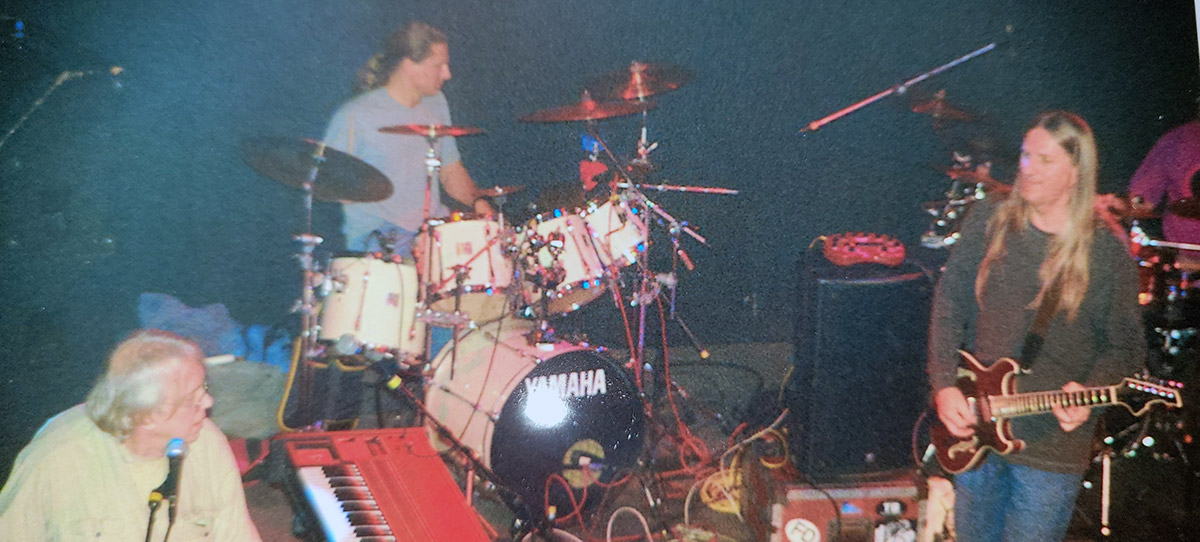
This episode includes full performance of the songs Life During Wartime, Henry, and Back Porch Boogie Blues, and a portion of the song You’re The Only One, all performed live by Max Creek with Greg Rosedale on August 26, 2006, at the Budweiser Amphitheatre at Papermill Island in Baldwinsville, New York.
Episode 35 transcription
You’re listening to Hooked on Creek, a podcast celebrating the music history and fans of the legendary jam band Max Creek. I am your host, Korre Johnson, and you are listening to episode 35.
Thank you for joining me on episode 35 of Hooked on Creek. I think you are really going to enjoy this one because it features my interview with Greg Rosedale. Greg is not only a huge fan of Max Creek, he’s also a drummer, and he’s had the opportunity to play drums with Max Creek several times over the years.
I met Greg briefly at Camp Creek last year, so I was excited to reconnect with him on this podcast to hear about his love of Max Creek, how he was first introduced to Scott Murawski, Greg Vasso, and Scott Allshouse, and how those relationships grew into giving Greg so many opportunities to perform with the band.
But before we get started, just a quick reminder that you can look in the episode show notes to find direct links to stream or download the music featured in this episode, or simply head over to hookedoncreek.com. And while you’re there, click the contact link and let me know what you think. All right, now let’s get started.
[intreview begins]
Korre: Greg Rosedale, welcome to Hooked on Creek.
Greg: Hey, thanks, Korre. It’s really great and cool to be on here. You know, I want to give you props before we get going here for the podcast because, you know, it’s been really cool to listen to the interviews with all the people you’ve done — whether it’s guys in the band, which is always great to just get sort of their perspective and stories I’ve never heard, but also people in the band in the past who I’ve had no experience with because they were there before I showed up, and then also just people, kind of side people like myself, that are friends or have sat in before — just to hear what’s going on with them and their take. So, it’s been really great to listen to. So, I appreciate it.
Korre: Well thanks, Greg. That’s really awesome to hear. I mean, I think fans of this podcast might have heard me say before that this project, I guess, if you want to call it that, has given me a lot of joy over the last few years, especially during the pandemic, just to have a way to connect with fans of Max Creek remotely from Milwaukee. And you describe yourself as maybe a side story of Max Creek. I’d love to explore a little bit more about that in our discussion today.
But Greg, as I understand it, you’ve been a fan of Max Creek since about 1992 and you’re a drummer. And over the years you’ve had the opportunity to sit in and play drums with Max Creek a handful of times, including for an entire show. So, I’m really just excited to get to know you and hear about your appreciation of Max Creek and your experiences seeing and playing with the band. So maybe to begin with, take me back to the beginning. How did you first get exposed to Max Creek?
Greg: It’s pretty similar to almost everyone you’ve interviewed, including some of the band members. You know, it starts with the Grateful Dead. I got turned on to the Grateful Dead late in high school. I graduated high school in 1989. I grew up in the 1980s. You know, I was a I was a rocker man. I mean, I was into Zeppelin, Rush, Metallica, Iron Maiden, the heavy stuff. And, I always knew about the Grateful Dead, but I don’t know, it just seemed kind of almost wimpy. You know, hippies — “Hey, man.”
And then a good buddy of mine who I’m still good friends with today. Mike. He was a big Deadhead, and he turned me on to the Dead just through, how am I going to put this — when you’re just kind of experimenting? He’s like, “Hey, check this out.” And he’s throwing a tape of like a second set Drums — started with Drums going to Space — and then come out of something. And I was always like, “So wait a minute, they do this every show, like this, drum solo thing?”
And he’s like, “Yeah, there’s two guys and they beat the crap out of their drum sets.” And I was playing drums back then and I was like, “Oh my God, Neil Peart’s the greatest drummer ever.” And then here are these two guys together. And it’s different every time. I was like, “Man, this is really cool.” And then the Space thing. I was like, they just make these freaky sounds and it’s just pretty wild. And then I’d be listening to it. And then, they always come out of Space with something, The Other One, or I Need a Miracle or whatever. And I was like, “This is really this is kind of cool.” I’m like, “I can’t believe I’m enjoying this.”
And then we made a deal where if he came and saw Metallica with me, I’d go see the Grateful Dead with him. And that all went down in 1989. And the first time I saw the Dead, July 4, 1989, in Buffalo, New York, and it’s sort of lame to say, but it literally changed my life. I mean, it was just an unbelievable experience. And so, then it was just, you know, I was on the bus and then I started seeing Max Creek stickers and Max Creek shirts and the same with Phish. And I’m like, “Well, who are these guys?”
And Creek always came to Rochester. Rochester has always been a huge Creek town. And I mean, they would play here back in the late 1980s, early 1990s. They were here three, four times a year doing a weekend. Problem is, they were playing a place called The Warehouse and it was 21 and over, and I wasn’t 21. And I mean, even when I was 21, I looked like I was 15. I was just always looked young. And there was no fake I.D. that I was going to get. So, I had to wait till I was old enough.
Well, then The Warehouse became this bar called the Horizontal Boogie Bar, and they went to 18 and over. So, I was like, “Great”. I was 20. I was like, “I can go see Creek.” So, I’d heard some stuff on tape, you know, friends had tapes, and it sounded great, but I’d really never seen them live. And so, then I went and saw them for the first time, and I was just like, “Wow, these guys are freaking amazing.” And, I became a fan and just from then on, I’ve been going to shows as much as I can.
Korre: So, in 1989, when you went to that first Grateful Dead show, you were in high school back then, is that right?
Greg: I just graduated. So, I’ve got a late birthday, so my birthday is in October. So, I graduated high school when I was 17. So, I went to my first show. I was 17, didn’t really know what to expect. I kind of knew some stuff, but I got there and it was just such a different vibe. I mean, everybody’s happy. I mean, I’d been to other concerts before, but like for harder stuff and I mean, I love the music, don’t get me wrong. I still go to all kinds of concerts all the time. I mean, people hear the stuff I go to normally and they’re like, “Wait, so you went saw Dead & Company and then a week later went and saw Iron Maiden?” I’m like, “Yeah.” Good music is good music. I mean, if a band is good, a band is good, and I like it, I want to go see them.
Korre: So, in 1989 or even the early 1990s, I mean, Grateful Dead were playing stadiums, a huge band. And so, you’re in Rochester and you’re being exposed to Max Creek for the first time. What was that experience like to have a much more intimate sort of experience with a jam band like Max Creek, when you’ve had experiences on the Grateful Dead size of a of a concert?
Greg: Well, obviously the coolest thing, I still remember walking into my first Creek show and my girlfriend, who’s my wife now, she was waiting tables and she had to work late and I was like, “Yo, I’ll pick you up from work, and then we’ll go down to the club and we’ll, you know, maybe catch the second set.” And we got in there right as the second set had started, they were in the middle of — at the time I didn’t know, but later on got the tape — they were in the middle of jamming Jones.
And so, I walk in, they’re jamming and walked right up to the front where I love to be in the front. I love to see what’s happening on stage. I love to watch the interplay of the guys in the band. Just watch what they’re doing. And plus, the closer you are to the front, the less distractions you have from people in the crowd and morons in the crowd.
So, I like to be up front as much as I can. I don’t always go there now. It depends on what the crowd’s like. You know, sometimes I like to hang a little farther back, like, right in front of the soundboard, get good sound, but also have a little space so you can get down and dance. Back a little bit, you don’t have as many jackasses that want to come up front because they’ve had, you know, too many beers and they think they want to make the show about them. “Everybody look at me. Pay attention to me.” I hate that, because I just want to focus on the band and listen to the music.
Korre: So, when you started seeing Max Creek in concert, was [Greg] DeGuglielmo still in the band?
Greg: No. So, he left and Vasso had been in the band, I think probably a year, maybe a little longer. And I mean, immediately I just was like, “This guy’s such a great drummer.” I loved how he just — first of all he plays hard. He just uses his toms, I mean, just so awesome.
Anybody will tell you. People give me crap all the time. Well, they used to, not so much anymore because I really don’t play much anymore. And I can get to that later. But my drum set, I mean, if you just walked in and looked at my drum set and you’ve been seeing Creek for a long time, you’d be like, “Wow, that looks a lot like Greg Vasso’s drum set, like circa 1994.” Because I bought my kit in like 1994, 1995. I put it together and it was heavily influenced by Vasso’s kit because I loved how it sounded. I loved how he played it.
He was a huge influence on me as a drummer. Drumming is a lot of thievery. You know, you go watch drummers and you’re like, “Wow, I like that fill. I’m gonna try to steal that and work it into my repertoire.” So, I borrowed a lot of stuff from him. Mickey Hart — I loved the way he used his toms. I was always trying to get stuff from him that I could use. Jon Fishman — just a ridiculous drummer.
But yeah, when I first started going to see them, I loved that you could get up close. You could see what’s happening. You can even sometimes hear them talking, between themselves, like, “What do you want to do?” And then you kind of can pick out what song is coming next.
Korre: So, at this point in time, were you already playing drums when you started to see Max Creek, or did your own interest in playing drums come after you started seeing Creek?
Greg: No, I was playing drums. I started playing in high school and I played with some friends doing some metal stuff, some hard rock stuff. I had a buddy who was in a punk band, and I messed around with that for a little bit, but we really didn’t play any gigs. It was more kind of garage band type stuff.
When I was in college, I was in a Dead cover band. We thought we were great, but we were terrible. It’s so funny, you think you’re like, “Man, we’re killing it.” And then years later, you go back and you find a tape and you listen and you’re like, “Oh my God, what were we thinking?” But it was fun.
I then started seeing Creek. January 1992 was my first show, so it’s literally been 30 years for me now. Then in October of 1992, a friend of mine was like, “Hey, I know this guy and he’s in a band. They’re looking for a drummer.” And I was like, “Yeah, I’m not doing anything right now.” So, I ended up hooking up with these guys. I’m still friends with a bunch of them. It was this local Rochester band called The Druids.
The lead singer guitar player guy, this guy Drew Moore, he put it together and it was called The Druids. Kind of like his name was Drew, but we spelled it D-R-U-I-D-S because if we spelled it D-R-E-W that just would have been too much. The bass player, Bob Beeley, is a Rochester guy and one of the biggest Creek heads I know. We’ve been to about a billion shows together. In fact, I think you met him at Camp Creek. I mean, I know you met a million people there, but he and his wife were there. And then this other guy, a good friend of mine, Pat Schnall, was the rhythm guitar player.
I started playing with these guys, and we were doing Dead and Allman Brothers and stuff like that, but they were big Creek heads. I knew Max Creek. I knew a couple of their tunes. I didn’t have a lot of tapes, but there was a ton of their stuff I didn’t know. We were doing Rainbow and it would be funny, we’d be practicing and they’d stop and Pat would be like, “So you got to kind of do this one fill that Degugs [Greg DeGuglielmo] always does.” And I was just like, “OK. How about you give me a tape?” No one ever had a tape.
Then we started working on The Field. And once again, The Field was a tune I didn’t know. I’d never seen them play it live. I didn’t have any tapes with it on it. And these guys just kind of started playing it. And I just started playing along with what I thought would fit and no one said anything.
So fast forward to August of 1993. Almost a year after I have been in the band. Max Creek is doing a weekend here in Rochester, and we go Friday night and the place is packed. Our lead guy, Drew, goes up to Scott Murawski before the show and is like, “Hey man, we have band practice at my house tomorrow afternoon. If you’re not doing anything, do you want to come jam with us?” And Scott being the guy he is, such a nice guy, he’s like, “Yeah, sure.”
So, all of a sudden, Bob or Pat, one of those guys comes over to me and he’s like, “Hey, man. Get to practice early tomorrow. We’re gonna work on some stuff because Scott’s coming to jam with us.” And I’m like, “I’m sorry, what? Like Scott who?” They’re like, “Scott Murawski.” And I’m like, “Yeah, OK. You’re real funny. Ha ha.” They’re like, “No, seriously. Drew just asked him. He’s coming to jam with us.” And I’m like, “Holy crap.”
Creek rips it up that night in front of just a packed house. And the next thing you know, he’s in Drew’s basement the next afternoon, walking in with his guitar and amp just like, “Hey, guys.” And we’re all just like, “Wow.” So, we set up and started jamming. We jammed a couple Dead tunes and then he’s like, “So you guys do anything else other than Dead?” And Drew’s like, “Yeah, we do a couple Creek songs.” And Scott was like, “Get out of here. You do not.” And he was like, “Yeah.” And so, he’s like, “Well, let’s go.”
So, we started playing The Field and we stopped at the chorus. Scott stopped us. He goes, “Hold on. You guys are doing the chord progression a little bit wrong.” And he corrected them. And then we started playing and we played it through. When we first started playing The Field, I used to play that song just straight through. Because you know how it slows down in the chorus and the beat slows down? I didn’t know that. And I had always just played it straight through fast. And none of those guys in the band ever were like, “No, dude, you got to slow down at this part. And like I said, I didn’t have a tape. I didn’t really know the song very well, so I was just playing how I thought it should be played.
So, we played it all the way through, and we finished and Murawski was like, “Hey man, I really like what you did during that song.” And I’m like, “Oh, OK.” And he’s like, “Yeah.” He goes, “Man, that chorus part, you played it straight through without slowing down. That was really cool.” I’m like, “Thanks a lot.” And I’m looking around like, “What’s going on?”’
So, we jammed for a little while longer and it was great. In fact, our friend John Hartman, who’s another Rochester Creek head who moved away — he’s down in Asheville, North Carolina, right now — he brought his taping gear over and taped it. I still have that tape laying around somewhere. We used to listen to it all the time just because it was just so much fun.
But so, then we go to the show that night. Now, bizarrely, the Saturday night show, Phish also happened to be playing right down the road from Rochester at an amusement park called Darien Lake. It’s like halfway between Buffalo and Rochester. So, the Creek show was dead. I mean, literally Friday night there were probably 300 people there. Saturday night, there were maybe 50 people.
Korre: Wow.
Greg: Yeah, because everyone went to Phish. So Creek comes out and opens with The Field, and he had Vasso play it straight the whole time, like I had done. And I’m standing there like, “Is this happening right now? Like, oh my God, this is crazy.”
And the show went on. And then it’s like almost to the end of the second set. And I’m standing there and I’m about 10 or 15 feet back from the stage, dead center, just getting the best sound. There’s not a lot of people. I got a great sight line, and I look to my left and Mike Gordon is standing right next to me. And I’m like, “This dude looks like Mike Gordon. And I’m like, “Wait a minute, that’s Mike Gordon.” And apparently what happened is when the Phish show finished, he jumped in a limo and cruised back to Rochester to catch the end of the Creek show.
So, the show ends, and I just wanted to go up to Scott and say, “Hey, man, thanks for today, jamming with us.” He told stories. It was great. And for Bob and Pat in the band, those guys had been seeing Creek since the 1980s. So, I mean, for them it was just mind blowing. And for me, it was really cool. And so, I just want to say thank you.
And I go up and he was talking to Mike. He saw me. And he’s like, “Hey, man.” I’m like, “Listen, I just want to say thank you.” And he’s like, “No problem.” He’s like, “What did you think about The Field?” I’m like, “Yeah, that was really cool.” He introduced me to Mike really quick. That was amazing. And then he’s like, “Hold on before you go.” He grabs Vasso and introduces me to Vasso. He’s like, “This is the guy I was telling you about.”
And Vasso kind of starts talking me up and I’m talking to him. Nicest guy in the world. I’m sitting there and I’ve got this stereotypical image of guys in bands that have any popularity and they kind of don’t want to talk to fans and they’ve got security and backstage stuff. And Creek was just a complete opposite.
And the next thing I know, Greg Vasso handed me a card. And he’s like, “Hey man, here’s my number.” He’s like, “Next time we’re coming into town, give me a call. I’ll put you on the guest list. Hang out, talk drum stuff.” And I’m like, “OK, Great.”
And so that’s how it started. And then every time that they were in Rochester, I’d give Vasso a call and we’d talk and he’d throw me on the guest list. And I’d go back in the back room and talk to Murawski and I kind of got to know them over the years and then got introduced to John [Rider] and Mark [Mercier]. They had this guy managing them for a long time, Eric [Freitas]. And the different sound guys they’ve had and I’ve just kind of got to know them.
And then when Vasso left, I still remember getting the email from him. He sent me this long email in like early 1996. And he’s like, “Listen, man.” He goes, “I’ve made the choice to leave the band. I’m going to join this band called Jiggle the Handle.” And I was just like, “No.” I was like, “Oh, man.” Because I loved his drumming. And he’s just such a great dude. And I’d gotten to know him so well.
So, then he left and Creek played, this was 1997. I think it was like February and Creek played in Rochester. I think it was Rochester and Syracuse. But anyways, the first time I saw them with Allshouse was in Rochester, and I went back to say hey to Murawski. And he’s like, “Come here, come here, come here.” And he’s like, “This is our new drummer, Scott Allshouse.” And it’s like they clone these guys from niceness.com or something. He couldn’t have been nicer. He’s like, “Hey, man. heard you play drums.” And I’m like, “Yeah, hey, nice to meet you.” And he’s like, “Come on out and check my kit out.”
And he had this drum riser thing he would put his drums on, and it angled them backwards so that when you sit in your drum chair, you’re leaning, like the whole thing is angled up. It looks like you’re going to be shot off the stage. And he’s like, “What it does is it puts all the weight down on your hips and in your back against the back of the chair so that your arms and legs can flow free.” And I’m like, “This is insane.” I sat down and I’m trying it out and it’s just really cool.
And then Scott’s like, “Hey man, here’s my number.” And I mean literally it was like the same thing happened with Vasso, but now happening with Allshouse. Then over the years, once again, I got to know him real well.
And then the first time I ever sat in with them, it was Sterling Stage, 1999. Phil’s Farm Party at Sterling Stage 1999. Allshouse was just like, “Hey man, you should come up and play one.” And I was like, “Wow, oh, OK.”
And everybody knows this that knows me, I was out of my mind nervous. Just insanely out of my mind nervous. And Murawski called me up in the second set to play The Field. And I got up there and I played it normal because once I learned how the song was supposed to go, I switched up how I played it and I played OK. And I made one mistake. I dropped a beat in the second, during the jam part.
But it was funny because after the show, everyone’s just hanging out. That place is party central. And John Rider comes up to me after the show and he’s like, “Hey.” I’m like, “Hey, John.” And I kind of was, I got to be honest, I was a little down on myself because I’m kind of a perfectionist. I don’t like making mistakes. And so, I was a little bummed. I had made kind of a mistake.
And he’s like, “Hey, I want you to know something.” I go, “What?” He’s like, “I was trying to get you to fuck up.” And I was like, “What?” And he’s like, “Oh yeah.” A couple times he was looking back at me and kind of making faces and doing kind of his bass thing he does. And I was like, “Jeez, John. OK.” It was just so funny.
But so, then it just started happening after that. Every now and then someone would be like, “Why don’t you come up and play one?” And then from there, Scott Allshouse — he runs a sound company, he has his own sound company — he started getting gigs that conflicted with Creek shows.
And the next year, the same gig at Sterling Stage over Labor Day weekend, he called me up. His sound company was doing sound for the US Open. And he’s like, “I’m flying in, playing the show, flying back down for the US Open.” He’s like, “Can you bring your drum set up?” And I was like, “Yeah man, no problem.” He goes, “Then I don’t have to worry about a kit. Then I’ve got a kit, and I know that you’re going to bring me a decent drum set. It’s not like I’ll use the band’s that’s playing before us because you never know what you’re going to get.”
And then all of a sudden, I kind of became — if there was a show in Rochester or Syracuse or Sterling Stage or something like that where Scott’s flying in — I became the drum guy where I would bring my drum set and set it up, and then he would play it. And sometimes they’d be like, “Hey, it’s your kit, sit in for a tune.”
And then it was sort of if Allshouse couldn’t play, they’d go to Vasso. If Vasso couldn’t play, they’d go to Degugs. And if the Degugs couldn’t play, Eric — their old manager, always used to rip on me — he’d be like, “Hey, it’s New York’s fourth string drummer.” Because if there was a New York show that those three guys couldn’t play. I was the fourth-string guy.
And then in 2006, right outside Syracuse, a little town called Baldwinsville, that was the show. It was actually after a show they did in Rochester in like April of 2006, John came up to me and he goes, “Listen, we got a gig in August, and we have no available drummers. Can you do it?” And I was like, “Yeah. Let me just check my calendar.” I’m like, “Yeah, if you guys need me, I’ll do it.”
And then a couple months later, I can’t remember who it was that called me. It might have been Eric that called me, their old manager, to confirm it, but then that was it. And that was after Rob had left the band. So, it was just me.
A funny story. So, the week before, I’m kind of practicing making sure my chops are up. I said, “You know what I should do? I should print out a list of songs to give to each one of the guys.” Like, “Here, are your songs that I feel comfortable playing,” because that way they know, “OK, I’ve got these songs to choose from. I’m not just pulling songs out of the air that Greg’s like, ‘Whoa, wait a minute, I’ve never done this.’”
So, there was a web page online somewhere that had all the Max Creek songs. So, I went through and I printed out, made a list of like 15 songs for Mark, 15 songs for John, 15 songs for Scott. Because I figured that’s plenty. I mean, they’re each only going to play, between two sets, probably going to do five, six songs at the most each. So, I figured fifteen is good.
So, I get to the venue, set my drums up, and the other guys are setting all their stuff up, and I pull out my sheets, and I go walking over to Mark, and I’m like, “Hey, Mark. Listen, I printed out a list of songs for you that I feel comfortable playing. So just kind of look them over.” And he goes, “Oh, thanks. This is really great. Great thinking, definitely.” And I’m like, “All right.”
So I go over to John, I’m like, “John, hey. So, I printed out a list of your songs that I feel comfortable playing. I just wanted to get them to you so you can kind of look them over and maybe have some idea of what would be good to go into. So that way you don’t start something and I’m completely lost.” He’s like, “All right, no problem.”
I go walking over to Scott Murawski and I’m like, “Hey, man. Listen, I printed out a list of songs that I feel comfortable playing, so I just wanted to give it to you so you could check it out. And he’s like, “Oh yeah.” And he takes the list and he looks down at it and he gets this confused, perplexed look on his face. And I’m like, “Oh, did I pick a song he hated? What’s going on?”
And he looks at me just with this what-the-fuck look on his face and then looks back down at the list and I’m like, “What?” He’s like, “Greg, these are all my songs.” And I’m like, “Yeah, I gave John a list and Mark a list.” He’s like, “Of all my songs?” I’m like, “No, no, no. They have a list of their songs.” He’s like, “Oh my God. I thought you just printed out a list like, ‘Scott, we’re only gonna play your songs tonight.’” And so, we were dying laughing at that one.
But then, of course, you probably know what the story is now going to go. The gig started and pretty much everyone pulled from those lists. Except, literally — I think it was in the first set — Mark just launched into Diamonds on the Soles of Her Shoes by Paul Simon, which I have never attempted to play that song in my life. I guess someone requested it in the crowd before the show. Mark was just like, doo doo doo doo doo. And I was like, “Oh no.” And I pulled it off. I’m like, “I’m gonna try this beat. All right, this is working.” I mean, I know the song. I just have never played it.
So that was funny. And then at the end of the night, I had asked Murawski, I said, “Listen, one of the favorite songs my wife likes that the band does, she loves Talking Heads, and she loves when they play Life During Wartime.” And I was like, “Could we play Life During Wartime?” He’s like, “All right, cool.”
And then at the end of the night, Scott started telling a story about him traveling up to the show with his kids and how they were listening to the Grateful Dead and some other stuff. And he promised them he was going to play this song. And he launched into Cassidy by the Grateful Dead, which wasn’t a big deal because I’ve played that tune a billion times. So that was fine. But I mean, it wasn’t on the list, but it didn’t make a difference.
And then we went right from that into Wartime, which was kind of cool. And I may say this and you’re like, “OK, whatever.” But honestly, during Life During Wartime, when Creek would do it, Scott would sing the line, “The sound of gunfire …” and Rob would always go up to his high conga and be like, da da da dat. It was like a staple fill from Rob. “The sound of gunfire off in the distance,” da da da dat.
And so, when we launched into it during that show and he starts playing it. I’m thinking like, “OK, is my tempo good?” Stuff like that. And all of a sudden, we get to that part and he starts singing it. You know, the brain works so fast. All of a sudden, my brain’s ahead of the song going, “Do that Rob fill.” And to my left on my drums, I have these two plastic wood blocks. And he was like, “The sound of gunfire off in the distance,” and I just nailed it. I mean, just absolutely nailed it.
And honestly, driving away from that show, I mean, there was a lot of other stuff I played that was I was like, “Yeah, that was really good.” But that stood out to me like as just the perfect fill.
And then in the encore that we did, Henry into Back Porch, which I was pretty psyched about that, too, — Back Porch, that wasn’t on the list — they launched into that, and I was like, “Here we go.” And they speed it up at the end. And I was just like, “All right, this is either going to be a train wreck or …” And just boom — just nailed it right on cue. So that was really cool. So, that’s how that gig ended up happening. I was kind of the New York State fourth string drummer for a while.
Korre: So, just to catch our listeners up. This was back on August 26, 2006. And my notes have it at the Budweiser Amphitheatre at Paper Mill Island in Baldwinsville, New York. Does that sound right?
Greg: Yeah, it’s this really, really cool venue right on the Erie Canal. I mean, you’ve got the canal on both sides, and then this stage. It’s just a really, really nice place to see a show. I’ve been to a couple shows there. It’s just a really cool place.
Korre: And I think you’re probably lucky because that show was recorded and it’s posted online. So, have you gone back and relistened to that show?
Greg: Oh, absolutely. I think I’ve listened to it about a thousand times. I have it on my phone. I’ve got like 100 live recordings of different bands on my phone, and that’s one of the ones I have for Max Creek, just because it’s probably the best I played with them.
I forgot this part. So back in, was it 2000? Yeah, it was 2000. That was the first time Allshouse was like, “I’m flying in. Can you bring your drum set?” And I was like, “Yes.” I brought my set. I set it up and Scott Murawski comes up to me and he goes, “Hey, man, Allshouse’s plane is late.” And I go, “Oh, OK.” And he goes, “So, what are you doing for the first set?” I’m like, “Playing with you?” And he’s like, “Yeah.”
So, I ended up playing the first set. That was the first time I did anything extended with the band. And I’ve gone back and listened to that a couple times, but I hate it because early on when I was sitting in with those guys, I would get super nervous, just because it’s like, I don’t want to do anything to mess up the music. I want people out in the crowd to just be like, “It’s Max Creek. Let’s go.”
And I don’t know, I just would get inside my own head. And once I started playing, I usually would be OK, but I sped everything up that show. Everything. I go back and listen to it and I’m like, “God. Why are you going so fast?”
And then that actually became a little bit of a running gag, people busting my balls and stuff like that. So much so that one, I think it was 2003. Yeah, it was 2003. Creek was doing a three-night stand in New York. They were playing a Thursday night in Buffalo at one of those free party-in-the-park type shows. They did Friday night in Syracuse. And then they were doing a Saturday late afternoon, early evening, gig at this place called Gloversville, New York, that I don’t think they’ve ever played at, this outdoor bar stage.
So, we all call it the Chicken Wing Tour because of this chicken wing thing that happened. But anyways, so we went to the Buffalo show on Thursday, typical decent show. Went to the show Friday night in Syracuse, which that was the blow-your-head-away show. I mean, that was the boom, bomb went off, amazing show. And Vasso was playing, Vasso was there all three nights.
And then the Saturday show in Gloversville, we all show up and we’re all hanging out. And I guess behind the scenes, Eric, the manager — and Eric loved to bust my chops about stuff and mess around — he went to Murawski and Vasso and said, “Hey, I got an idea. Let’s get Rosedale wasted and then bring him up to play Sympathy for the Devil with Vasso singing.” And they were like, “Let’s do it.”
And so, Eric then told my friends Bob and a couple other people. So, I was broke. I did not have much money. I got into the show and I was just like, “I’m just gonna hang out. I’m not gonna really drink.” I like to have a few beers if I’m at a show. I wasn’t driving, so I’m not worried about that. But all of a sudden, people just start coming up and handing me beers because there’s this whole behind the scenes, like, “Let’s get Greg really drunk and then have him come up and play with Creek.” And so, I don’t know this is going on.
So, all of a sudden, my friend Bob Beeley, who doesn’t drink, comes walking outside out of the bar and we’re all just kind of a bunch of us standing in a circle talking. And he’s like, “Man, the weirdest thing just happened.” And we’re like, “What?” He goes, “Well, I went up to the bar, and I ordered a ginger ale, and the guy gave me this glass full of Jägermeister.” And I mean, picture a soda glass. I mean, this isn’t a shot of Jägermeister. This is a soda glass full of Jägermeister.
And I’m like, “Wait a minute. What? That doesn’t even make any sense. You ordered ginger ale.” And I go, “Who pours that much?” He goes, “Yeah, here, Greg, why don’t you take it?” And our friend Pat, who didn’t know what was going on, is like, “I’ll take it.” And I kid you not, like 10 people all were like, “No!” at the same time. And he just froze, like, “What’s going on?”
And I’m looking around and I’m like, “Wait a minute. What is this? People are handing me beers.” I’m like, “You just brought out a glass full of Jägermeister.” And then they’re like, “Oh, man.” And I’m like, “Something’s up.” And then they were like, “Yeah, Eric wants you to get drunk so you can go up with …” And I’m like, “I’m fine. I can sit in just fine.”
And we did. I went up later, I think for the encore, end of the second set, and did Sympathy with Vasso coming out and singing. I did that a few times, and that was always one of my favorite things in the world, because it’s a rocking tune and man, Vasso just every time crushed it. Just so much energy. And I mean, I’m a rocker at heart, man. I love it when bands just come out and grab you by the collar and just shake you around with their music, and that’s one of the Creek tunes that when they do that, that does that. So, that was always a blast.
But yeah. It’s been a lot of crazy funny stories over the years and bizarre things that have happened that have, you know, one thing leads to another.
Korre: 30 years, right?
Greg: Yeah.
Korre: So, you have some perspective maybe on the scene that has surrounded Max Creek over this time. How do you think it’s changed, maybe from the early days from when you were seeing Max Creek until now. What’s the crowd like? How has the music changed or what hasn’t changed maybe?
Greg: Wow. I mean, the music, it hasn’t really changed much in that, I mean, first of all, every time you go see them, you’re going to see, I mean — if they play Jones, you could see Jones 50 times and it’s going to be slightly different every time you see it, just in how they play it, the tempo, how the solo progresses. It’s always something different.
Obviously different drummers play things differently. I mean, Vasso played tunes differently. Allshouse played them differently. [Bill] Carbone plays them differently. And Degugs and [Bob] Gosselin, they were before my time. Honestly, man, listening to your podcast, I didn’t know squat about Bob Gosselin, but being able to listen to that interview, that was so cool. Just kind of hearing how it started and how he ended up leaving the band, all that stuff.
And then Degugs, I actually became friends with him since then because actually he came into Rochester and played a couple shows here with them, and I’ve met him and I think he even used my drum set one time. So, I mean, I’ve become friends with him as well. But hearing his background and everything that happened, it’s been really cool.
But each of those guys does something different, which can change a song. And sometimes, I mean, honestly, sometimes you’re like, “Ah, man, I don’t know if I really like that change,” whether it’s slowing it down or just a different type of tempo beat. Other times you’re like, “Man, that was really cool what they did.” Those are the biggest changes I’ve noticed.
In terms of the crowd and the fans, there are a lot of hardcore Creek heads that I go to shows and I’ve been seeing there, and whether they’re from Rochester or the New England people, they’re still there. There have been a lot of people that were there and are now gone. And the crowd, it’s definitely gotten older, but you’ll still see young kids showing up.
I’m a teacher and I’ve been teaching for 26 years. Very rarely do I go to a Rochester show, and I don’t run into a former student that’s now an adult and got into Max Creek. Some kids got into Max Creek because I used to have a Max Creek poster in my classroom until I had to take it down because they were painting the walls and it ripped. It was a bummer.
But anyways, there were kids that were like, “What’s Max Creek?” and I’m like, “Oh, it’s a band.” And when they got older, they got into them. And now I’ll run into them at shows, which is great.
But the crowds unfortunately have gotten a little bit smaller. When they come and play Rochester, it depends. Sometimes they’ll bring in a great crowd. Other times it’s not that great. And they always just come out and they’re like, “We’re just gonna play.” And they kick ass.
Korre: After 50 years, over 50 now, it’s incredible for any band to keep it going that long. When you think of all the things that could have happened to not have a band stick around, what do you think is pushing them along to keep it moving ahead, and to keep putting on these shows and bringing fans together?
Greg: It’s got to be the fact that they love doing it. I mean, that’s got to be what it is. They just love getting up there and making that music, whether it’s in front of 25 people or it’s in front of 2,500 people. They love getting up there and doing it. That’s the only thing I can think of.
Because I know me personally, I don’t really play that much anymore. I just sort of fell out of playing drums because life got too busy. I mean, I had three kids and two of my boys played hockey and my daughter was into cheerleading. And it got to be real difficult getting home from a gig at 3 in the morning and having to get up four hours later to go to a hockey game. And it just kind of stopped becoming fun. And it never used to be that way. It was always fun. It was always fun setting up, and not only was I setting up drums with bands I played, I would help set up sound, and you play the gig, then you break it down. It was always fun.
And then all of a sudden it just reached a point where it just wasn’t really fun anymore. It was like work. And I was like, “Man, this isn’t really what I want it to be.” And I just sort of stopped playing. And I have more fun going and watching people play now. Creek hasn’t asked me to sit in in a long time, and I am fine with that. Because I really haven’t been playing anymore and I wouldn’t want to get up there all rusty and fuck up the music. I just wouldn’t want to do that. I mean, if they called me up for one tune, I could do that. If it’s just a regular, basic type tune, I could get up there and pull that off.
Korre: If they asked you for one song, what’s the one song you’d love to play right now with them?
Greg: Oh, man. Wow. Well, I got to be honest, one of my top favorite Creek tunes of all time is Just a Rose. Just because every time they play it, it’s literally they grab me by the collar, and they just shake me around. And I love that. And it’s a type of tune that just explodes at the end.
And I actually got the chance once to get up and play that with them. Actually, a couple times I’ve gotten up and played that with them. And when you can get up and play your favorite tune with a band that you absolutely love, I mean, that’s like movie script stuff. It’s just something that you just never think, “I’m gonna get the chance to do this.”
So, I mean, I’m very, very appreciative of the fact that I’ve been able to do that and to be able to become friends with those guys and get to know them because they are, all of them are, just the nicest guys in the world. I mean, just so gracious. And I can’t thank them enough for being the way they are. Because it’s just been such a great experience to get to know them on a personal level, but then also be able to go out and whether I was up on stage playing with them or down in front dancing around like a moron, it’s just been a lot of fun.
Korre: Hey, Greg, this has been just so awesome that you took the time to talk with me today. I should acknowledge we’re recording this on Sunday, January 16. And you had other plans for this weekend, didn’t you?
Greg: Yeah, unfortunately I did. Right now, I probably would be hanging out on a beach in Mexico outside Cancun, getting ready for my third Dead & Company show at Playing in the Sand. But that all kind of fell apart because of Covid, as so many other things have over the past couple of years. I think it’s like 8 degrees here in Rochester, New York, right now. So, it is what it is.
But honestly, again, I got to thank you. Anytime I can hang out and talk set lists or Creek or tell stories about Creek and music, I mean, I love to do it. I don’t just love hearing the music, I love talking about it, breaking it down, telling old stories. I mean, when we all get together to go to Creek shows, all my Creek friends, there’s just so many stories we run from past years — some about the shows and experiences and side characters and funny things. So, hearing that perspective from other people you’ve interviewed and band members and stuff, it’s really great. I hope you keep doing it.
Korre: Well, thank you so much. All right. Greg Rosedale, thank you so much for joining me on Hooked on Creek.
Greg: Hey, man. No problem. Thank you.
[interview ends]
All right. Now let’s keep things rolling and play some music featuring Greg Rosedale sitting in with Max Creek. During the introduction to this episode, I played a portion of You’re the Only One from Max Creek’s performance with Greg Rosedale on August 26, 2006, at the Budweiser Amphitheatre at Paper Mill Island in Baldwinsville, New York. And now I’ll play a few more tunes from that same show. This is Max Creek with Greg Rosedale performing Life During Wartime.
And now, this is Max Creek with Greg Rosedale performing Henry into Back Porch Boogie Blues.
And that concludes episode 35 of Hooked on Creek. Big thanks again to Greg Rosedale for sharing his stories on this podcast. I really hope you enjoyed our conversation. Do you have a story to share? If so, let me know. You can get in touch with me via the contact link on the Hooked on Creek website at hookedoncreek.com or via Facebook, Twitter and Instagram. Just search for Hooked on Creek to get connected. I look forward to hearing from you. Thanks for tuning in!