
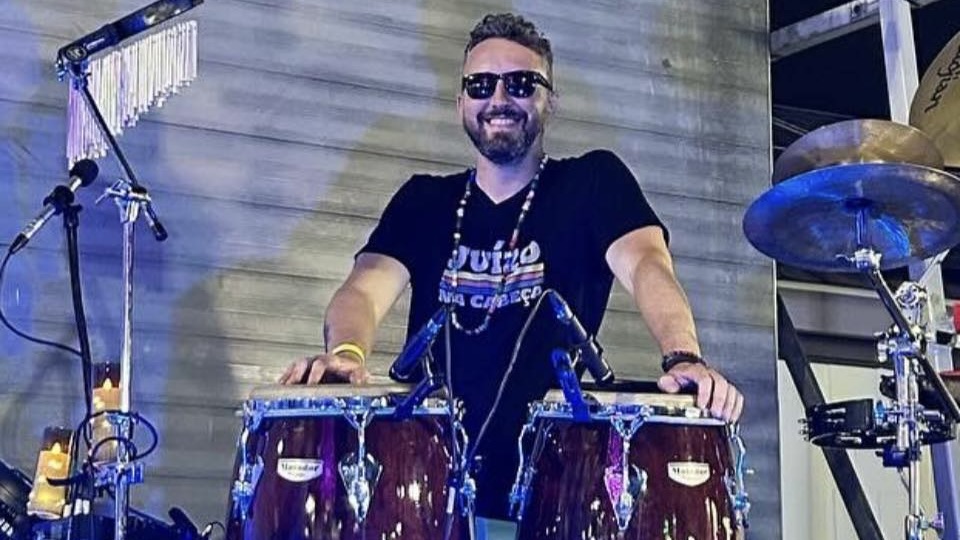
Episode 62 features my conversation with Brendan Hodge, a musician and devoted Max Creek fan whose musical journey was profoundly shaped by the band.
In this episode, Brendan shares memories of discovering Max Creek in the late 1990s, the inspiration he drew from their live performances and how the band influenced his path as a performer. Brendan also talks about his role as a percussionist in the band Little Lies.
This episode also features clips of the following songs performed live by Max Creek:
- Blood Red Roses performed at The Met in Pawtucket, Rhode Island, on February 3, 2018
- You Let Me Down Again performed at The Living Room in Providence, Rhode Island, on May 1, 1999
- I Will Always See Your Face performed at Soundcheck Studios in Pembroke, Massachusetts, on June 4, 2022
Transcript of episode 62
You’re listening to Hooked on Creek, a podcast celebrating the music, history and fans of the legendary jam band Max Creek. I am your host, Korre Johnson, and you are listening to episode 62.
Welcome back to Hooked on Creek. In this episode, I’m joined by Brendan Hodge — a lifelong musician and passionate Max Creek fan whose musical journey was profoundly shaped by the band’s live performances. Brendan shares memories of discovering Max Creek in 1998 at The Living Room in Providence, Rhode Island, where the powerful presence of percussionist Rob Fried and drummer Scott Allshouse left a lasting impression on him as a young drummer.
Now a percussionist himself in the Fleetwood Mac tribute band Little Lies, Brendan reflects on how those formative Max Creek experiences continue to influence his playing and appreciation of live music. We also talk about the nuanced relationship between drummers and percussionists on stage, his favorite Max Creek songs and venues, and what he believes is the magic that keeps Max Creek fans coming back show after show.
Whether you’re a longtime Creek Freak or just discovering the band, I think my conversation with Brendan offers a unique look at how Max Creek’s enduring sound continues to inspire musicians and fans alike.
I had a lot of fun talking with Brendan and I am excited to share our conversation with you. Alright, now let’s get started.
[interview begins]
Korre: Brendan Hodge. Welcome to Hooked on Creek.
Brendan: Hey, thank you very much, Korre. Thanks for having me. I’m super excited to be here tonight.
Korre: Brendan, to begin our conversation, go ahead and introduce yourself to me and tell me about where you’re from and your background in music.
Brendan: Sure. My name is Brendan Hodge. I grew up in a town called Seekonk, Massachusetts, which is sort of in the southeastern part of Massachusetts. I started playing music from an early age. I was around my parents playing music on the piano, and I had a grandfather who was a sort of a ragtime stride-type piano player. So, I have a lot of early memories of hearing music just around and close by — close enough to feel the vibrations. Ever since then, it’s been a big part of my life, either formally or informally, but it’s never really gone away. And it’s one of those things that sort of keeps drawing me back.
Korre: And as I understand it, you are a performing musician, is that right?
Brendan: Yes, that’s correct. So, I’ve been playing drums since I was about 12 years old. However, these days I’m playing percussion in a regionally touring tribute band. It’s called Little Lies Tribute, a tribute to Fleetwood Mac. So, I’m the percussionist in that band right now.
Korre: Oh, cool. So, how long have you been in the band?
Brendan: The band came together at the very end of 2023. A year and a half now, things have really ramped up. The band is working every weekend, multiple times a week, and it’s just been terrific to be able to get out there and to play and perform in the way that we are.
Korre: That’s really cool. But as I understand it, you are also a fan of Max Creek. And when you reached out to me, you had mentioned that Max Creek has been an influence to you as a musician. So, talk to me a little bit about where Max Creek has influenced you or how they influenced the sound and the music you create.
Brendan: Absolutely. So, I first became aware of Max Creek probably around 1998. At that time, my friends and I loved going to see shows — any local live performances we could see. You know, we were in the school band and the jazz bands, and we were active in our school music community. So, we were always looking for reasons to go out and check out some live music. So, one day, an older and much cooler musician in the band said, “You guys got to come check out this band, Max Creek. They’re playing at The Living Room.”
Just for the listeners’ sake, this was the third iteration of The Living Room. This was on Rathbone Street in Providence. So, I knew of the venue. Some of my friends had actually played there before. It was a place that had a reputation for giving young bands sort of a chance to play. And so, I’d been there a few times and they were welcoming to us. So, a big shout out to the late Randy, who organized The Living Room, and for giving us those chances.
So, my first show was probably October 23rd, 1998. And what I really remember about that was the quality and the intensity of the show — the sound, the lights, everything. And so that was really mind-opening at the time. At the time, the percussion section would have been Scott Allshouse and Rob Fried on percussion, Mark, Scott and John. And this was the lineup that hooked me, I would say.
I was playing primarily drum set at the time, but what stood out to me was the joy and the passion that I saw Rob Fried playing with — a big smile on his face and just looked like he was having so much fun back there. And you know, that’s something I think I could do. That’s something I think I want to try and do someday. So, I would say from that moment, the seed was there for what might be possible for me as a player. And I’ve sort of been slowly following that path ever since.
Korre: The Living Room in Providence, 1998. Take me into that room. What does it feel like to be in that club?
Brendan: It was exciting and horrifying at the same time. Not the most well-kept type of place. It seemed a little rundown, a little dingy, dark and smoky, but very welcoming for a group of teenagers that had some cash to spend and were looking to raise some ruckus. So, it was a place that we fit right in. And the music was mesmerizing. We couldn’t take our eyes off the stage. So, it was just a matter of how close could we get and, you know, how did we want to sort of experience the night.
Korre: So, were you into music of that genre like Grateful Dead and Phish and jam bands, or was Max Creek sort of out of the ordinary for your normal music?
Brendan: I recall friends at the time sort of discovering Phish. So, I would say Phish more so than Grateful Dead. I’ve since done some homework on the Grateful Dead and have discovered a lot of their music. But at the time, we were listening to a lot of Phish. And as you know, Mike Gordon and Scott Murawski have their own connection. So, the way it all sort of came together was just really serendipitous, I would say.
Korre: So, at that time, you were a drummer. Talk to me about Allshouse and Fried. What were you seeing up there? What were you experiencing as somebody who may be appreciating it in a different way?
Brendan: Yeah, I mean, we were just having so much fun checking out the gear and the setup and how the drums were miked. To us, this was such a higher level of sound and precision than we were used to seeing in our own circles. But it was so close. It was so approachable. We were able to engage with it, and it was just powerful — the vibrations, the room just shaking and humming, tones in the space. I couldn’t get enough of it.
Korre: So, in the band you’re in now, talk to me about that relationship on stage between the percussionist and the drummer. What is that like, this relationship that the two of you have on stage in the music?
Brendan: I’d say it’s all based on communication. Sometimes it’s spoken and verbal understandings of how we’re going to approach something. But a lot of times it’s just listening to what the other person is doing. And for me, I really see my role as sort of harmonizing rhythmically with what Mike, our drummer, is playing in terms of the groove that he’s locked into.
So, for me, the first thing is listening to what he’s doing and then responding in a way that’s going to complement and supplement what he’s doing and what is serving the song. With Fleetwood Mac, people are aware of their catalog and they expect it to be played a certain way. So, for me, I’m listening in terms of what is the audience expecting to be hearing now, and then how am I serving my role as the percussionist in this bigger picture, with seven or eight people on stage together.
Korre: What’s it like for you to be up on stage? Is that thrilling? Scary? What’s it like?
Brendan: I’ve always enjoyed performing — probably from a young age, ever since I was in the seventh-grade pep band playing at basketball games. But it’s actually funny the way that Little Lies has sort of taken off in the last year or so. We’re playing some of the same venues that I had a chance to see Max Creek at. I’m on the same stage where I saw these guys play, in a role doing something that I had envisioned myself doing.
Little Lies Tribute was playing at the Broad Brook Opera House in Connecticut, which is a venue that Max Creek plays. And so, for me, walking around the space and then in sort of the barroom area, they’ve got a signed guitar in a tabletop — Max Creek. And it’s just like pinching myself. So, it’s really been a dream come true.
Korre: Well, I’m curious. When you look at the band Max Creek over the years, they’ve had different drummers come and go. Obviously, Jay Stanley is in the band now. When you look at the band over time, is there an era of Max Creek and their drumming — or maybe percussion — that stands out to you? Or how do you look at that?
Brendan: I love it all, to be honest. I don’t have one era that stands out. I’m partial to the Rob Fried–Scott Allshouse era just because it was so formative for me at that time. But in the 25-plus years since then, every time I go to a show and I see Bill and Jay doing their thing, it’s fascinating, and it’s just a joy to watch and observe these players doing what they do at such a high level. So, I find it completely inspirational. Any chance I can get to see a show, that’s where my eyes are glued 90 percent of the time.
Korre: So, when you’re at a Creek show, where would somebody find you? Would you be up front, in the back? Where’s your spot at a Creek show?
Brendan: It probably depends on who I’m with. Personally, if I had my choice, I would be up close and toward the front somewhere. Being able to see these guys — these masters — doing what they’re doing, especially at the front line, after so many years playing together, that chemistry, the nonverbal communication, the nods, the head tilts — it’s just fascinating for me as an observer. So, I like to be as close as I can get.
Korre: So, after you started seeing the band in 1998, where did it go from there? Were you always seeing them? Did you catch them a lot, or how did it go after that?
Brendan: I would go as often as I could. I’d catch them at The Met and some of the Rhode Island shows, went out to Levon Helm Studios and saw them there a couple of times. But I was also married and had a young family, so balancing my family life and responsibilities with I want to go and see this band.
Korre: Yeah, I know what it’s like. I have a different set of challenges in Milwaukee trying to see Max Creek. Have you had an opportunity to meet the band or interact with them over the years, or exchange any words?
Brendan: No, I haven’t. Just a nod here or there in passing, but I haven’t had a chance to meet any of the guys. Someday I’d love the chance to, if that’s in the cards, but if not, that’s OK too. Just another happy fan appreciating the art from a distance.
Korre: Well, over the years, as you’ve seen Max Creek, where are your favorite venues to see them? What is the best place for you to see Max Creek?
Brendan: For me, the shows at The Met have been particularly memorable. Seeing them there and being up close and in such proximity has been great. And there’s something really special about Levon Helm Studios in Woodstock, New York. I’m so glad I made the drive out there with a buddy of mine to see them out there. There’s something special about that building and that room. But overall, I haven’t followed the band to a whole lot of different venues. I kind of stick with what I know or what I can do. I would say The Met, the Old Living Room, Soundcheck Studios is an awesome venue, too. They’re all a little bit different in their own way.
Korre: Do you have any songs that you really want to see? Like anytime you go to a Max Creek show, you’re just wishing they play that one song.
Brendan: Certainly. From those first shows, Blood Red Roses always gets me going. I Will Always See Your Face — I love the changes and the rhythmic interplay on that. And lately, over the past few years, You Let Me Down Again — it just hits me in a different way. It’s interesting how where we’re at in our life and what’s going on, the way these songs affect us in the moment. But for me, those three really stand out. I love the song Three. I know we don’t hear that too much, but that’s another one that’s just a beautiful song.
Korre: What do you think it is about this band that has created this love by the fans for everything they do? I’m in Milwaukee on a podcast, and I’m talking to you. What is it about this band that has clicked with so many people? For those that have found them, they’ve stuck around. What do you think is so special about Max Creek?
Brendan: I think Max Creek has a universal appeal. I think their music is so broad and so deep that there are many different access points for people to find their way in. I was thinking about some of those first shows I went to, and how I didn’t know any of the songs per se, but yet they felt like I knew them. I think Max Creek draws on so many influences and from so many different places that you don’t have to go very far to find something to connect with. So, for me, I feel like their appeal is because there’s really something for everyone.
Korre: As a percussionist, when you set up on stage, what type of choices do you make on the gear that you have on stage, and how do you approach that?
Brendan: Sure. And again — Rob Fried and Jay Stanley — observing, what are they doing, what do they have? Set of congas, a set of bongos, set of timbales, some temple blocks, cymbals, chimes, tambourines. So, my rig has been growing steadily over the past couple of years at this point, but I’m always looking for different textures and different tones that are going to supplement and serve the song. I love playing the congas. I love playing the timbales. And then as a drummer — playing bell patterns on a cymbal or hitting a mounted tambourine. It really depends. But there’s something different for every song.
Korre: Is it true that every band should have a percussionist? Because I feel like they should. I mean, come on.
Brendan: Absolutely.
Korre: What do you think the future holds for Max Creek? This band’s been around for so long. Are we just lucky that they’re still playing, or what do you want from Max Creek at this point?
Brendan: I think Max Creek has already given me anything and everything I could have hoped for. Every time I get a chance to see the band these days, I consider that a blessing, and I’m counting my lucky stars for another opportunity. Looking at the band’s history and how much they’ve done — even before we were born, never mind when we sort of came online and discovered them or found them. So, I really treasure any opportunity that I have to see them. What the future holds? Who knows. But hopefully it’s going to include many more years of doing their thing and bringing joy to so many people.
Korre: You have had music in your life for such a long time. Why is music such a big part of your life?
Brendan: I think for me, it gives my hands something to do. Rhythm is all around us — from our heartbeat to the calendar, to the sun, to the bills we got to pay. Rhythm is such a part of life to me that I couldn’t imagine life any other way. Music in general and specifically Max Creek have just enhanced my life and brought me peace and joy and opportunities to connect with people, to develop friendships, and to meet new people. Like we’re talking here tonight. I’m just so thankful for all of it. I don’t take any of it for granted. Whether that’s in my own playing, or seeing Max Creek, or just playing the radio, I try to treasure every opportunity.
Korre: Brendan, for those who want to learn more about Little Lies, tell me more about the band, who’s in it, and how they might find out where to catch the band?
Brendan: Absolutely. littleliestribute.com is the website. That’s going to have all of our current tour dates all across New England this summer, this fall, and into next year. You can find me online @brendanhodge44 on Instagram, Brendan Hodge on Facebook if you want to connect that way.
And I just want to thank those folks in the band for taking a chance on this Creek Freak. That’s Mike Carlucci, Sara Achorn, Adam Joe, Art Papa, Avery Markle, Chuck Nemitz, David Lockeretz and Mike Young.
Korre: Awesome. You are on this podcast, and I’m so happy that you took the time to be with me.
Brendan: Likewise. Thank you for doing this. Because for a long time, I just had my memories and my YouTube and questions about this stuff. So, you bringing all these people together, and being able to hear it from the players and all these people, has just been terrific. And now, through Little Lies, I met Katie Mae — the keyboard player In Harmony — I think you spoke with her. Our sound guy, Mike Young, actually played with Scott. He played in a Dead tribute called Fennario for a long time out here. So now it’s like, “Dude, you played with Scott.” And I’m making these Creek connections in the wild. It feels great to do that and to find those connections. So, I appreciate you bringing it all together.
Korre: Is there anybody out there listening right now that you want to say hi to?
Brendan: Absolutely. I want to say hello and say thank you to my parents, Paul and Judy Hodge, for giving me the opportunity to learn and study music, for driving me to lessons and gigs and coming to see me at gigs, even these days. Without them, I certainly wouldn’t be here. And of course, my lovely wife, Andrea Hodge, for all of her ongoing support as I’m loading up the car to head out to another gig. I love you, Andrea, and I couldn’t do this without you.
Korre: Brendan Hodge, it was great talking with you. Thank you so much for joining me on Hooked on Creek.
Brendan: Thank you very much, Korre. It was really a pleasure to be here and to talk with you, and I really appreciate it.
[interview ends]
Big thanks to Brendan Hodge for joining me on the podcast and sharing his perspectives on Max Creek. It was a real pleasure talking with him and learning how the band has influenced his journey as a musician and continues to inspire him. As a reminder, you can learn more about the band Little Lies by visiting the website littleliestribute.com. I encourage you to check them out as soon as you get the chance.
If you are curious, this episode featured a clip of Max Creek performing the song Blood Red Roses live at The Met in Pawtucket, Rhode Island, back on February 3, 2018. I also played a clip of Max Creek performing the song You Let Me Down Again live at The Living Room in Providence, Rhode Island, on May 1, 1999, and I played clip of Max Creek performing the song I Will Always See Your Face performed live at Soundcheck Studios in Pembroke, Massachusetts, on June 4, 2022. You can find links to stream or download all of this music in the show notes.
Alright, that wraps up this episode of Hooked on Creek! If you have feedback about this episode or suggestions for future episodes, please visit hookedoncreek.com and click the contact link to send me a message. I would love to hear from you. Thanks for tuning in!