
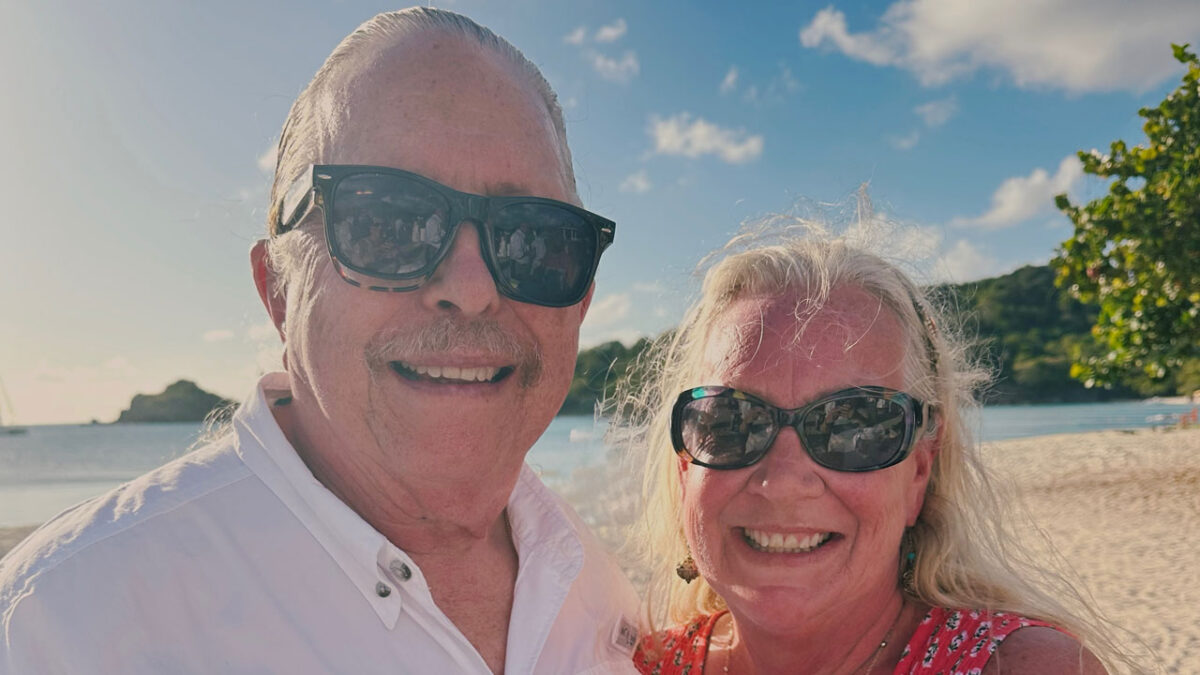
Episode 68 of Hooked on Creek features my conversation with Sally Rider — lifelong fan of Max Creek, wife of bassist John Rider, and founder of Rider Productions.
Sally has been at the heart of the Max Creek story for more than five decades. In this episode, Sally discusses how she fell in love with the band’s music as a teenager, her memories of meeting John Rider and raising three boys alongside the band, and her role in producing beloved festivals like Camp Creek.
Sally also shares her unique perspective on the band’s enduring legacy, her favorite venues, and her pride in watching her son Clayton carry the family’s musical heritage forward on stage.
This episode also features clips of the song Wild Side performed live by Max Creek at Eastover Resort in Lenox, Massachusetts, on April 26, 2003.
Transcript of episode 68
You’re listening to Hooked on Creek, a podcast celebrating the music, history, and fans of the legendary jam band Max Creek. I am your host, Korre Johnson, and this is episode 68.
Welcome back to Hooked on Creek. I have another very special episode lined up for you today, so thank you for joining me. While so much of what makes Max Creek special happens on the stage, some of the most remarkable stories belong to the people standing just off of it.
In this episode, I am joined by Sally Rider — lifelong fan of Max Creek, wife of bassist John Rider, and the founder of Rider Productions. Sally has been part of the Max Creek story for more than five decades, from driving through Connecticut snowstorms to see the band as a teenager, to building a family alongside the band as John Rider’s partner, to producing Camp Creeks and bringing the band’s community together in ways that only she can.
In our conversation, Sally talks about how she fell in love with John, the early days of touring and raising a family alongside the band, and what goes into producing a festival like Camp Creek. She also shares her memories of some of the band’s most beloved venues, her perspective on what makes Max Creek so enduring, and her pride in watching her son Clayton carry the family’s musical legacy forward. We also get into questions submitted by fans of Max Creek who wanted to hear directly from Sally.
It was a lot of fun talk to Sally, and I think you are really going to enjoy this conversation. Alright, now let’s get started.
[interview begins]
Korre: Sally Rider, welcome to Hooked on Creek.
Sally: Well, thanks for having me, Korre. It’s nice to be here.
Korre: Maybe the best place to begin is at the beginning. So, tell me, how did you first meet John Rider?
Sally: Well, I guess I imagine that would be the first question. I have to go back a little earlier than that though because I really fell in love with the music before I did the man. And what did that mean? It meant I grew up in West Hartford, Connecticut. And we had snowstorms back in the day. And it didn’t matter. When I was in high school, we drove everywhere to see Max Creek. So, this is going back — I was 15 and my brother was 16, so he had the license. He had the guys in the car and I had the girls. So off we’d go and we’d go see Max Creek. The Hartford Advocate was the paper back then and that’s how you kind of found out who was where and where they were playing.
So, I fell in love with the band, very much so. And I took their music with me to college. I went down to the University of South Florida. There was quite a bit of Grateful Dead awareness there, but being down in Tampa, Florida, there wasn’t a lot of Max Creek — until I got there. I mean, I completely turned on anyone that would listen. It was either Bob Weir was being blasted, or it was John Rider, Scott Murawski, Jerry Garcia, and a little bit of Pearl in there as well. So that’s how that kind of all went.
And I came back from college and immediately we started going back and seeing Max Creek. We had friends that were friends of friends, so we kind of knew each other. Obviously, we had been going to shows all over, so it was easier for us to know them than for them to know us, right? I was at a Talking Heads concert, and John sat behind me. And then I heard something about he went to the health food store that I worked at and was looking for me, and that never happened.
Then we were at Mohawk Mountain at a show, and John came off the stage, came out into the audience, and he came up — kept coming up and up the mountain. He came up to me and said, “Hi,” and he asked me out on a date. And I said, “Great.” So, we went out, and it was interesting, Korre, because we were like best friends. Talk, talk, talk, talk, talk, talk, talk. And we didn’t really go out right after that. I think I just thought he was a really nice guy and a good friend. And then a friend of ours, Mark Gionfriddo, hooked us up on a blind date, and I think that’s when, that day, I realized how a best friend is actually love. We both realized very quickly that we wanted to spend the rest of our lives together.
Korre: Wow. So, you mentioned your exposure first came through being a fan of Max Creek in high school, is that right?
Sally: Absolutely.
Korre: Roughly what years was this, just to put it in the context of the band’s history?
Sally: I was going to shows in ’75 and ’76. We were hitting the old clubs — Rocking Horse, Pentangle Pub, we’d go to Mad Murphy’s. I think later was the Lithuanian Hall, those were really great shows. But of course, The Inn Place in Simsbury, that was one of our early haunts. So, I know I was in there when I was 16, 17. Drinking age was 18, so they let the girls in or else the guys wouldn’t stay, right? That’s the way it went.
Korre: What was the reputation of Max Creek at that point in time in the mid to late ’70s? What type of band were they, and what type of fans showed up to their shows?
Sally: You know, we were hippies. We definitely were. We were the beads. We were the long dresses. They were the long hair. They were older than we were, and we kind of looked at them as just the music of our day. They were the cool guys, and they were the best music. There was no doubt in our mind. We’d go around to everything, but Max Creek was kind of a place where you ran into people that you knew, that you wanted to know, and that you wanted to spend more time with.
Korre: At some point in time, as your relationship with John grew, your relationship with Max Creek must have grown, too. So, talk about your connection to the band or your relationship with the band Max Creek as you were dating John and forming that relationship with him.
Sally: Interestingly enough, he had tried to find me — before he came off the stage, he heard I was managing a health food store somewhere. And I was, and he never found it. But the long and short of it was Rob Fried, and his twin Gary and his parents — his dad especially — they had a health food store in Simsbury. Well, I ended up buying it. So, I kept on that Fried piece of the band, and we spent a lot of time over at Rob’s house when we were dating, no question about it. He lived in Simsbury. And here I was taking over the family business with the health food store. John and Scott are brothers and that just all fell into place. We’ve just been a family since day one.
Korre: What did it take for Max Creek to be successful, maybe in the late ’70s or the ’80s? Because as I understand it, in the ’80s, they started really touring a lot. They had a lot of shows every week, every month, every year. What were you seeing from your perspective, close to John and as a fan of the band? What did it take for Max Creek to do that?
Sally: You know, they loved it. They were happy to be on the road. Again, my relationship with John was such that I had the health food store, so I was busy in my own life. We had Sundays off. It got a little trickier after we got married and I had all these babies, and then he was gone Wednesday, Thursday, Friday, Saturday — that became a lot more. And I would say that the family got even deeper in ways that people would never realize.
People like Bobby Harries — he would always come over and make sure that I was OK in snowstorms. John would be in Rochester and he would bring in wood, visit with me, and we’d spend a lot of time together. That was just kind of the way he was. And that’s kind of how the whole Max Creek family was. They were just always there for each other, and we always have been.
Korre: You and John ultimately got married, and you have three kids, is that right?
Sally: We do. We have three boys. We got married in my parents’ backyard. My mother loved John Rider more than myself! She loved him.
Korre: What did she like about him?
Sally: I remember the first time John walked into my family’s home to meet my parents. There were a bunch of people over that day, so there was only one chair left in this big room in the back of their house, the family room. And it was the chair where his back was going to face my mother and my father. He sits down, with the long hair, and they were just like, “Oh god, here’s Sally with another one of these boyfriends, right?”
By the end of the day, my mother was talking music, opera, and symphony, and she and John could talk about their passion for music all day long. My mother adored John Rider, and she adored our children. So again, we dated for seven years, so towards the end, my mother made a point to always have John’s family join our family for holidays. Because his sister lived in Boston and they were down south, so we were somewhere in the middle. By the time we got married, our wedding — everybody knew each other on both sides of the family.
Korre: A lot of people might know you, Sally, also through Rider Productions. Do you want to take a moment to explain what Rider Productions is and how that fits into your life?
Sally: I sold the health food store and decided to go into the corporate world. I started a 10-year career with Fleet Bank, and I became their event planner — an event coordinator for seven states. They were one of the largest banks in the country, so I was kind of all over doing these events. At one point, I remember bringing John in because he had started Video Rider Productions and he was doing video work. I’d bring him in to video my events, and I remember having to tell my boss, “Hey, by the way, it’s my husband.” And he said, “Well, OK, even better.” I said, “OK, great.”
So, I did that for 10 years, but then Bank of America bought Fleet, and they wanted to move me down south. I didn’t want to do that with the babies. I didn’t want to leave my family, my parents, my brothers and sisters, and all of my friends that were up here when I had babies. So, I decided to start my own company. I dove out, and that was in 2004, and I started Rider Productions. I’ve just been riding that train ever since.
I’ve produced all kinds of corporate events and conferences and, obviously, people that may know me know that I produce festivals, like Camp Creek and whatnot. We still do it to this day. It’s an international company — we are all over the world with our clients, and we’re also international travel agents, so we manage corporate and personal travel all over the world, which is a lot of fun because John and I travel quite a bit now.
Korre: Is John Rider on stage different than John Rider at home versus John Rider at work? Are these three different people or are they all pretty much the same guy?
Sally: They’re pretty much the same guy. You know, John Rider’s a cool cat, right? He’s a very thoughtful, patient, mindful person, and he never loses track of that. So, whether you see him on stage being his jumping-up-and-down self at times — you’re not going to see that in the corporate arena, but you do see this very level-headed person who can pretty much fix anything that goes wrong technically or otherwise.
And at home, John is such an amazing father. He’s got a wealth of information that he has taught to his boys. It started with scouts — John’s father was a Silver Beaver, John was an Eagle Scout — is an Eagle Scout. His boys loved being out and camping, hiking, knots, sailing, and anything to do with the outside world. I’m happy to say they all still adore that. It’s a huge part of their life.
But as they got older, then they got into the music, and then they got into the company and how to run sound equipment, editing equipment, video, and lights. All of a sudden, they were interested in production. With little bits of this, that, and the other, I feel like he has just been the most amazing father. He’s a calm, loving force, and we just adore him.
John and I are so proud of our three boys. Gratton is just a super people person. He knows everybody, he grew up with everybody, and he stays friends with everyone that was his elders, but now are his friends. He is our sound engineer for the company and does an amazing job.
Tristan is our lighting director. He is incredibly talented with lighting. But behind the scenes, he manages everything — all of our equipment for Rider Productions — and just maintains it and forces me to buy new equipment all the time, which I know he’s right, but you know, I have the purse strings! So Tristan is just the backbone of the company in that way.
And Clayton, he comes on the road with Rider Productions, and he does a little of everything. And therefore, he knows a little about everything, so that’s a wealth of comfort to have that as well.
Korre: From your perspective, what was it like for your children to see their father up on stage? Was that interesting for them or was that difficult for them to understand who John Rider is on stage versus their dad?
Sally: Well, they never knew anything different because when they were little fellows — first off, John held every one of them up on stage like The Lion King when they were born. So, they literally grew up holding on and sitting at his feet, holding onto the microphone stand, taking naps on the side of the stage, and sitting on my lap over on the side of the stage. They never knew any different.
Those who were elders have become friends to them, and now they’re just part of the big family. Because, of course, Max Creek is about our kids and our grandkids, and the generations have gone on and on. They never really thought of John as anything other than their father and the guy up there that plays bass.
Korre: We’ve talked a lot about John. How have you gotten to know other members of the band?
Sally: Well Korre, I’ve had the opportunity to kind of know everybody at some point, really. You have to kind of go back to the days when we had John Archer doing sound and Linda Cournoyer doing lights. Arch was a funny guy to be on the road with. A lot of great times with Arch, and of course, he was very artistic and he did a lot of the artwork that’s in for the band. So there’s all that, and of course, then on stage: drummers.
I mean, Bob Gosselin, one of the funniest men you ever wanted to meet. We had great, great times with Bob. And then we had Greg DeGuglielmo, we had Greg Vasso — lot of great times with those guys. Clearly sad to see both of them go. We also had the drummer Scott Allshouse. I became very good friends with his wife as well. They live in Granby, so we still get to see each other now and then. Another drummer that we lost, but again, moved on to greater things and I understand all that.
Of course, we now have Bill Carbone and Jay, who’s part of my family. He spends a lot of time sleeping over at our house or on vacation with us, and he’s just become so close to my family and my boys and whatnot.
And then of course, I haven’t talked about Mark Mercier, who is such a staple of the band and one of my closest people in the world. I feel like Mark would do anything for myself and John, and he’s just the kindest person. I think he actually, along with Joe Ryan, played the wedding march when John and I got married. So, I’ve always had such a great, great friendship in Mark Mercier.
Korre: Sally, my first exposure to you, if my memory is correct, was at Camp Creek in 2021. It was my first trip out to see Max Creek and I remember driving into Odetah Camping Resort, up to the entrance, and I remember you saying, “Oh look, Korre’s here. I’m so happy,” or something like that. I don’t think you know how much that meant to me to have somebody welcome me, and to have you welcome me. It meant a lot to me. That was the beginning of an incredibly magical weekend. Of course, I came back to Camp Creek the next year, too. I just want to say thank you on behalf of all the fans for putting on Camp Creek and putting on these special experiences. They’re just incredible. So, thank you.
Sally: Well, you know what, you dove right in with heart and soul. You weren’t trying to take over anybody else’s role or be somebody you weren’t. You were just a passionate person that wanted to be involved. So how can we not have open arms to that kind of thing? You’re still welcome, and everybody has welcomed you with open arms by this point.
Korre: One of the things I remember at that Camp Creek in 2021 and the following year in 2022 is being exposed to different artists on the lineup at each of those Camp Creeks, including different female artists I had not heard of. I’m curious from your perspective, what goes into choosing who should play at Camp Creek and were you intentional in finding female artists to be on stage?
Sally: Well, that directly goes to the second year because the first year that we were at Odetah, I ended up with all kinds of male bands, with maybe a smattering. So, was it intentional when I chose those bands? You bet it was. I did a lot of homework. I had help from people like Bill Carbone. I certainly had help from my kids because they had the pulse of the market and they’re out and about. I really fell in love with Mikaela Davis, Karina Rykman, and who else did I have on that lineup?
Korre: Melt was a really good one. I liked that.
Sally: Melt, of course! I spoke to all of their agents and I put out an offer to all of them. Unbeknownst to me, it turns out they all knew each other — those women. They had gone to school together, they had spent time in New York together, and they all said yes. So, I ended up with an amazing lineup and I think it turned people on to some very cool music there.
Korre: Very much so. Can you speak a little bit about the behind the scenes of an event like that? I mean, I saw a lot of people doing some amazing work to make the experience friendly, the resort clean, and just to have the best time possible for Max Creek fans and those who brought their family. But I know there’s a lot of work that we don’t see. How would you describe the amount of work that goes into putting on an event like that?
Sally: Well, I kind of knew when I found Odetah — I had been looking and had gone to a number of places in all different states — and when I found Odetah, I knew it was where I wanted to be. I knew I had to fix up that beach, I knew I had to bring in a stage, all that kind of thing. But it was already a pristine park. The thing about it was that they had folks that moved in and lived there all summer long, so they were very proud and respectful of what they already had. It just so happened that the owner was a huge fan of Max Creek.
He didn’t know how his folks were going to react to the band, but when we got on site, the respect that our fanbase brought to that campground was beyond belief. Nobody left a paper cup. It was left better than when we found it. So, no matter what I brought in, what we did, and how we advanced it, I can’t speak highly enough of our fanbase for leaving Odetah more beautiful when we left after a massive festival. A little bit of everybody was involved in all of that, but sure, it was a lot behind the scenes.
Korre: Well, Sally, in preparation for my conversation with you, I had fans of Max Creek submit questions to me that they wanted me to ask you. So, the first here is from Dave Bonan. He wants to know, how many times have you been to Max Creek, Virginia?
Sally: Oh, Dave. A number of times. Many, many times. John’s family is from down there, so we would always go down in the summer and we would spend time. We would always go to Max Creek. John’s an Eagle Scout, so we would go where his early scouting days were. We fell in love with a house that was in Max Creek and came very close to buying it. It just didn’t make sense for us, so we didn’t. But that’s where his family’s from. That’s where I met everybody. That’s where his grandmother fell in love with me. “Wear yellow, you’ll catch a fellow” she said to me when I had a pretty yellow top on. That’s where I got to know that little boy and who he was and how he was brought up. So, many times, Dave. Many times.
Korre: Cristina Ryan wants to know your favorite Max Creek song.
Sally: Oh, I guess I thought that was probably going to come around. I can’t probably pin one. Obviously, Wild Side is in there. July Woman that John sang that for me at our wedding. There are too many to really say, but that’s a hard one.
Korre: Well, I would like to know, did John write Wild Side about you?
Sally: Well, you’ll have to ask John! I think “when she swings her yellow hair” it kind of gives it away.
Korre: Yeah. Don Bean wants you to describe what it was like to see Max Creek in the 1980s.
Sally: Late ’80s or early ’90s, it was pre-kids and the band was on the road. We had a nice crew and trucks, and off we went. We stayed in all kinds of crazy band houses and condos, this, that, and the other. Nantucket was a favorite time out there for sure. In those band houses, people would be sleeping in closets and we didn’t care. It was fine, it just didn’t matter. The days out to Colorado obviously were such fun, and going to all the Camp Creeks early on. We enjoyed what we were doing, we felt free. Just a lot of good people making a lot of good music.
Korre: James Mclellan wants to hear your perspective on how Max Creek was able to balance their touring schedule in the early days with family and life outside of music.
Sally: It was a lot. It was a lot, no question. We would bring our kids on the road. So, many times you would find our babies underneath soundboards or underneath Linda’s lighting board. We’d tuck them under there, and more often than not, there were Pack ‘n Plays on both sides of the stage. So, we had our kids with us, and when we didn’t, we didn’t. The guys went out and did their thing, and they came home, they got some sleep — caught up. Why did they go on the road and do what they love? Because they wanted to come home to their families. We all had kids around the same time, and our kids loved being at Max Creek.
They have great memories of Camp Creeks. They have great memories of times like Block Island — I remember it was at The Atlantic, and we had the kids — we had Linda’s son Jason with us and a bunch of kids. The staff at The Atlantic saw these kids and they were like, “What are we going to do?” They went to the back, they came up with boxes, and they made this whole trail where the kids went up and down the hill all day long sliding on the boxes. It just became a thing where everybody kind of expected the kids to be there. Meanwhile, I was backstage with Linda and Amy shooting spitballs at the band. We had fun when the kids were around! We had a good time. We balanced it and made it work.
Korre: Daniel Bowser wants to know if we can expect another Camp Creek in the future.
Sally: It’s never a no. If the time is right, maybe so.
Korre: Your son Clayton is also a musician. What is it like for you to watch him carry forward the family’s heritage?
Sally: It’s phenomenal. Absolutely phenomenal. I’ve been seeing him perform since he was young. He started playing with John and singing with John in church many moons ago, and I still enjoy that so — on Easter morning when they perform at church together. There’s nothing more special in my heart than to see that. But the other thing about it is when he’s performing, then I’ve got Gratton and Tristan who have set up the sound and his mic — they’re there, too. Whether Clayton’s on the stage alone or not, we’re all there around him.
But his music — he graduated summa cum laude from Berklee College of Music. I’m incredibly proud of him. He’s very talented, and he’s got a lot going on that the public will probably hear soon. He’s always in the studio working. He does have his own flair of music, and it is exciting, yeah.
Korre: Well, I heard a recording of him performing with Max Creek. I think it was July 4th, 2021. He stepped up on stage with Max Creek. I think this was the Sunset Concert Series that was at Salmon Brook Park in Granby, Connecticut. I’m just curious what it must be like to see your son and your husband in Max Creek, because like you said, you were a fan of Max Creek in high school, and here you are now this many years later. What was that like to see them together performing?
Sally: It’s totally kick-ass because he’s a guitarist, so he’s up there with Scott and they are having such a good time. It’s gotten only better and better, and I like it when Scott looks over to the side of the stage and gives me those eyes like, “Shit, this kid’s good!” So, I love that they’re having a good time together, and I love that they can play together so comfortably. He’s jumped up on stage a few times.
I remember way back when, at a Camp Creek in New York, Clayton had written a song, and the guys came over to our trailer for a rehearsal. They rehearsed it, and then they gave him feedback. He wrote an extra verse, they wrote a little piece together, and he performed it. He was a teenager. He was not in college. They’ve all been really encouraging, and I love it. I love it so much.
Korre: You must have seen Max Creek at so many different types of venues, locations, and crowds. I’m curious from your perspective, what makes a good Max Creek show?
Sally: Well, I guess part of the reason that I wanted to do Camp Creek, the Sunset Concert Series, and things like that is the outside. I like music outside. I like to be dancing in a field. I think there there’s just nothing more special about people being in a field together with the music they love, the people they love, and the food that they’ve nurtured and taken care of to bring — it’s special if they grew these berries or whatever it all is. So to me, my favorite is Max Creek outside.
Korre: It sounds like you like outdoor venues, but what were some of your favorite indoor venues to see Max Creek?
Sally: I guess we have to go back to the Agora. The Agora Ballroom was just a launchpad of crazy fun for many, many times. We had a great relationship with the owners there. I actually ran the ticket office. I managed the money behind the scenes for those shows. I remember many a night with a gun on the desk. It was serious — it was cash back then. There were no credit cards, we had big crowds, and we had a lot of fun at The Agora Ballroom. It’s a highlight, which goes back to one of those other questions about the ’80s, but The Agora Ballroom was a real special place.
One other venue that has always been a fan favorite and that we loved as well was Eastover. I know my son Clayton — one of his early memories would be from there. The Murawskis and the Riders shared a house on the property, kind of over on the back side of the bison field. So, the kids had to walk by these huge bison every time we went up to the stage and back. I remember Clayton wearing his Hagar the Horrible helmet — this hat that he had — and it had horns on it. The bison would come over like they thought he was part of the family!
That was a cool place. Everybody had rooms that were all around each other, being in the inn or out in the back, but we all ate together — all of our meals. So, it was all of the band, all the crew, all the fans, all the staff and we had all of our meals together. There were shows that were inside at night, but then they were outside in the back during the day, so everybody was happy and there was a lot of music all weekend long. Eastover was a really great spot.
Korre: Sally, Max Creek, in my opinion, stands out as one of the most enduring bands in the jam band landscape, and you’ve had a front-row seat to so much of the band’s history. What do you think makes Max Creek so special and unique?
Sally: They let each other be who they are. They give each other the respect and the time on stage to flourish, navigate, and experience different sounds, flows, and rhythms. I think it’s just all about respecting each musician, and they’ve each had it. Nobody’s trying to be the big shot, the big guy — it’s never been like that. It’s always just an equal, equal share of camaraderie on the stage, with an enormous amount of talent.
Korre: Sally Rider, I had a lot of fun talking with you. Thank you so much for joining me on the Hooked on Creek podcast.
Sally: This was fun, Korre. You’re the best. Thank you so much for everything that you have done over these many years supporting the band, getting the word out, and telling the stories. I’m glad to have been able to have some time with you. It’s just great.
[interview ends]
Big thanks to Sally Rider for joining me on the podcast and sharing her unique perspective on Max Creek. I learned a lot and I hope you did, too. If you are curious, this episode featured clips of Max Creek performing the song Wild Side live at Eastover Resort in Lenox, Massachusetts, back on April 26, 2003.
That concludes episode 68 of Hooked on Creek. If you have feedback about this episode, please visit hookedoncreek.com and click the contact link to send me a message. I would love to hear from you. Thanks for tuning in!