
Episode 70 is the final episode of Hooked on Creek.
After 69 episodes and more than seven years, I look back on how this podcast started, what it became, and how grateful I am for Max Creek, its fans, and everyone who listened along the way.
This episode also features a clip of the song That’s What They Say performed live by Max Creek at Camp Creek at Odetah Camping Resort in Bozrah, Connecticut, on September 12, 2021.
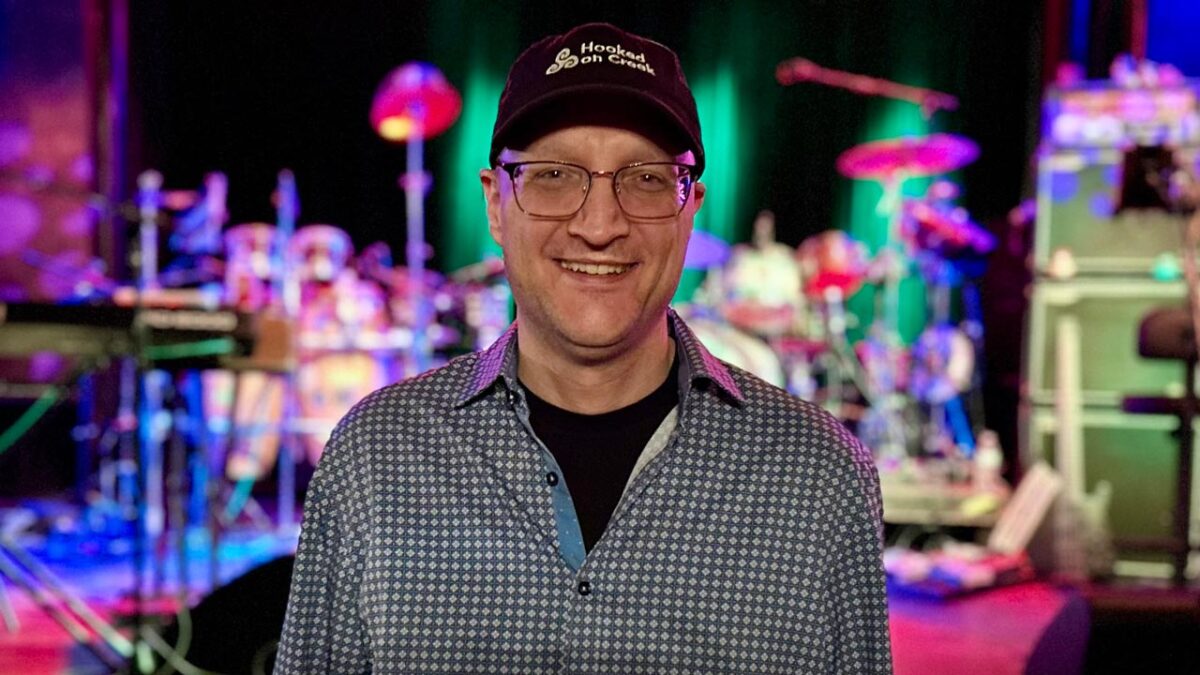
Transcript of episode 70
You’re listening to Hooked on Creek, a podcast celebrating the music, history, and fans of the legendary jam band Max Creek. I am your host, Korre Johnson, and this is episode 70 — the final episode.
When I recorded the very first episode of this podcast back in May 2019, the intro was a little shorter. I called Hooked on Creek “a podcast celebrating the music of Max Creek.” That’s all I thought this would be — just the music. It took me a few months to figure out that the music was only part of the story. The history and the fans came into the podcast later, and they ended up being the heart of the whole thing.
After 69 episodes and more than seven years, I’ve decided Hooked on Creek has run its course. So in this final episode, I want to look back on how this all started, what it’s meant to me, and how grateful I am for this band, for this community, and for you.
But to really understand what this podcast has meant to me, you have to know where I’m listening from. I live in Wisconsin. That’s a thousand miles from Connecticut, a thousand miles from Max Creek, and a thousand miles from the scene that has carried this band since 1971.
Sometimes I wonder what it would be like to be you, to have grown up with this band, and to know Max Creek not only from recordings on archive.org, but from being there — in a club, at a festival, in the rain, in the cold, or on a boat — with friends you’ve known since high school or friends you made at shows along the way.
That isn’t my story. But I know I am lucky. Because even from a thousand miles away, I found this band — my favorite band.
It started in 2017, when my friend Nate Warren and I went to see a Mike Gordon show at the Pabst Theater here in Milwaukee. I had no idea who the guitar player on that stage was, but I could not take my eyes off him. He was killing it. When I got home that night, I looked him up. His name was Scott Murawski, and that search changed my life.
Minutes later, I was on YouTube watching Max Creek play Fire on the Mountain at Harry’s Harvest Party in Granby, Connecticut, on September 20, 1981. I remember looking at Scott in that video and thinking, “Is that the same guy I just saw on stage?”
And then I found the archive — decades of live shows, all waiting for me on archive.org. That’s when this band came into focus. I started to understand how long they had been together, how many styles they could move through in a single show, and how deep their roots ran in the Grateful Dead scene.
And then there were all those original songs that sounded like nobody but Max Creek, yet somehow felt like songs I had always known on some deeper, cosmic level.
I couldn’t understand how a band this good had been completely unknown to me, or how, after all those years, they were still together and still jamming this hard. I became a little obsessed. I listened to Creek every day, with my headphones on in the basement after the kids went to bed. And I had nobody to share it with. That’s really where this podcast came from.
In May 2019, I launched Hooked on Creek with a simple idea. I would pick a Max Creek show on archive.org, talk about what I heard, and maybe, in some small way, help spread the word about a band I loved. And honestly, it was a little selfish, too. It gave me a place to finally talk about Max Creek, even if I was mostly talking to myself. I thought it would be a hobby, a creative outlet, and something fun to do in my spare time. I had no idea what it would become.
Before I recorded anything, I sent a note through the Max Creek website to let the band know what I was planning. I didn’t know if anyone would write back. But Bill Carbone did. He was warm and encouraging from the very first email, and that set the tone for everything that followed.
Over the years, I reviewed shows from across the band’s long history. Every time, I was trying to do the same thing — point people toward the shows that capture the creativity, power, passion, and love this band brings to the stage, and maybe help someone discover a show they would come back to again and again.
But the reviews of live shows were only the beginning. Pretty quickly, this podcast started to become a place for conversations. When I started, I didn’t plan on doing interviews. And I certainly never imagined I would be talking with members of the band. But that changed fast.
My first two guests were Dave Burland in episode 5 and John Spignesi in episode 9. Both of them took a chance on me, and those conversations showed me what this podcast could be. Dave came back for episodes 13 and 20, and John returned for episode 63. Thank you both for being there at the start and for sticking with me.
Early on, I also got connected with Dave Bonan. Dave was my guest in episode 19, but most of what he did for this podcast happened behind the scenes. He connected me with band members and fans. He shared history and context I never could have found on my own. He helped me understand the impact of this band in ways I hadn’t realized. And when I finally made it to a show, Dave went out of his way to welcome me. Dave, thank you for everything.
Those early interviews gave me a taste of what was possible. The next step felt like a big one: reaching out to someone who had actually been in the band.
I still remember the day I finally did. I sent a direct message on Twitter to Greg DeGuglielmo, about six months after I launched the podcast. Degugs said yes. He was so generous with his time and his stories, and he gave me the confidence to really lean into this. So I did.
After episode 14, I went on to talk with every band member from every era of Max Creek, from 1971 to today. It was incredible. It was honestly unbelievable. And through those conversations, I was also able to help tell the story of Rob Fried and celebrate his legacy in the band, as well.
Looking back, I’m really, really proud that all the band members shared their stories on this podcast. They didn’t owe me anything, but they trusted a fan from Milwaukee with their memories, and I don’t take that lightly.
So thank you to John Rider, Scott Murawski, Mark Mercier, Bill Carbone, and Jay Stanley. And thank you to Dave Reed, Bob Gosselin, Amy Goodusky, Greg DeGuglielmo, Greg Vasso, and Scott Allshouse.
As a fan, getting to have those conversations with you is something I will never get over. I am so lucky.
But the band is only half of this story. To know Max Creek is to know the people who surround it. So I also made a point of talking with fans, musicians, and the people who work alongside the band. A lot of you reached out over the years with ideas for who I should talk to, and you helped me make those connections. Thank you for that.
And thank you to Kate Whelan, Moriah Andrade, Scott Hall, Gary Backstrom, Frank Messina, Greg Rosedale, Fred Moore, Willy Ackerman, Tom Flanagan, Dylan Kader, Peter Hurley, Julee Avallone, Jimmy Jennings, Bill Hoy, Kenny Johnson, Phil Simon, Graham Gibbs, Brendan Hodge, Michael Wegner, Mike Maresca, Sally Rider, and Linda Cournoyer for joining me. Every one of those conversations brought new context, new stories, and a fuller picture of what this band means to so many people.
There are also two more guests I want to take a moment to remember. Toni Fishman and Eamon Cronin are no longer with us.
I connected with Toni just before Max Creek released their album Acoustic Live at The Stafford Palace Theater. Toni’s company, TELEFUNKEN, produced it and I was honored to play a small part in helping promote it via this podcast, while also sharing Toni’s deep love for Max Creek and the role he played in this community.
Like a lot of my guests, I met Eamon through Dave Bonan. Before our conversation, I only knew Eamon as a name that showed up now and then as a guest drummer or singer on live shows I listened to. Then we talked on the podcast, and I learned about Eamon’s long history with this band, his friendship with Rob Fried, and what a gifted musician and performer he was. I felt lucky to help share his story so more people could understand and appreciate it.
Toni and Eamon, your stories live on. I am grateful I got to play a small part in telling them.
Through all of these conversations, something happened that I never saw coming. It’s the part that turned this podcast from a hobby into one of the most meaningful experiences of my life. The Max Creek community found me. And they welcomed me in completely.
When I started this podcast, I had never seen this band live. I had no history with the scene, no connections, and no credentials other than a real love for the music. And yet people who had been going to shows for decades, people who grew up with this band, people whose lives are woven into the Max Creek story, welcomed me like I had always been there.
They reached out. They shared their stories. They trusted me with their memories. And over time, they became my friends.
Then, in 2021, I finally flew out to see Max Creek in person for the very first time. My friend Nate came with me, and he’s been with me at every Creek show I’ve seen since. We went to Camp Creek in 2021, Camp Creek again in 2022, and the Creekend at The Met in Pawtucket in January 2025. That’s three trips and six shows. Nate, thank you for saying yes every single time.
Nothing could have prepared me for those trips to see Max Creek in person. Every time, the band went out of their way to make it special. They talked with me. They showed me around. They brought me backstage and introduced me to old friends and longtime fans. They treated me like someone who belonged there, not like a stranger with a podcast.
And then there were the moments I will never forget — the moments when the band called me out from the stage and told the whole room that I had come all the way from Milwaukee to be there.
I don’t have the words to fully describe how that felt. It was overwhelming. Here I was — the guy who spent years listening alone in his basement, who started a podcast just to feel like he was part of something — and Max Creek was telling all of you that this little podcast had become part of their story.
So, that idea of this podcast becoming part of the Max Creek story brings me back to Tom Flanagan.
Tom joined me twice on this podcast, first in episode 45, when he was just starting to write a book about Max Creek, and again in episode 67, when he told me it was finished. It’s called Max Creek: A Rumor in Their Own Time.
When I started this podcast, I had a loose idea of what it would be and how it could showcase the band. Tom took on something much bigger. He’s a gifted author and a natural storyteller, and he brings this band’s history to life with a writer’s craft and a fan’s heart. It’s exactly the kind of book this band has always deserved. You can learn more the book at maxcreekbook.com.
And I was so happy to learn that Tom looked to this podcast as one of his sources while he was writing. Knowing that my story and this podcast helped him, in some small way, tell the story of Max Creek means more to me than I can say. Tom, thank you.
That brings me to a question some of you might be asking. Why end the podcast now? The simple answer is that it feels like the right time. Over these 70 episodes, I’ve said what I came here to say. I’ve shared the music I love, told the stories I wanted to tell, and asked the questions that kept me up at night. This podcast has always run on passion and curiosity, and I don’t want to keep going just for the sake of going.
In episode 65, I asked a question: If Max Creek was the only band you ever loved, would it be enough? I’ve been sitting with that ever since. And my answer is yes. It’s more than enough.
Back in episode 46, four years in, I said I wasn’t sure how long this podcast would last, but I knew my love for Max Creek would never end. Well, the podcast is ending. The love isn’t. I’ll keep listening and keep exploring the archive. And I hope I’ll see some of you at a show.

So before I go, I want to say thank you one more time. To everyone who listened, whether you’ve been here since episode 1 or you found this show last week, thank you. Your messages, your feedback, and your love for this band made every episode worth making.
Thank you to the Creek Freaks, and to the tapers who hauled their gear through snow and heat so those nights didn’t vanish when the music stopped. Without you, there would be no Hooked on Creek. And thank you to everyone who opened their arms to a stranger from Milwaukee and made him feel like he belonged. Your kindness meant more to me than you will ever know.
To every guest on this podcast, thank you for sharing your time, your stories, and your passion. You made this show something I never could have made alone.
And finally, thank you to Max Creek — John, Scott, Mark, Bill, Jay, and everyone who has been part of this band’s long and remarkable journey. Thank you for the music. Thank you for the kindness. Thank you for the community.
One last thing, if you are curious, during the introduction to this episode I played a clip of Max Creek performing their song That’s What They Say live during Camp Creek back on September 12, 2021, at Odetah Camping Resort in Bozrah, Connecticut.
That concludes episode 70, the final episode of Hooked on Creek. Thanks for being here.