
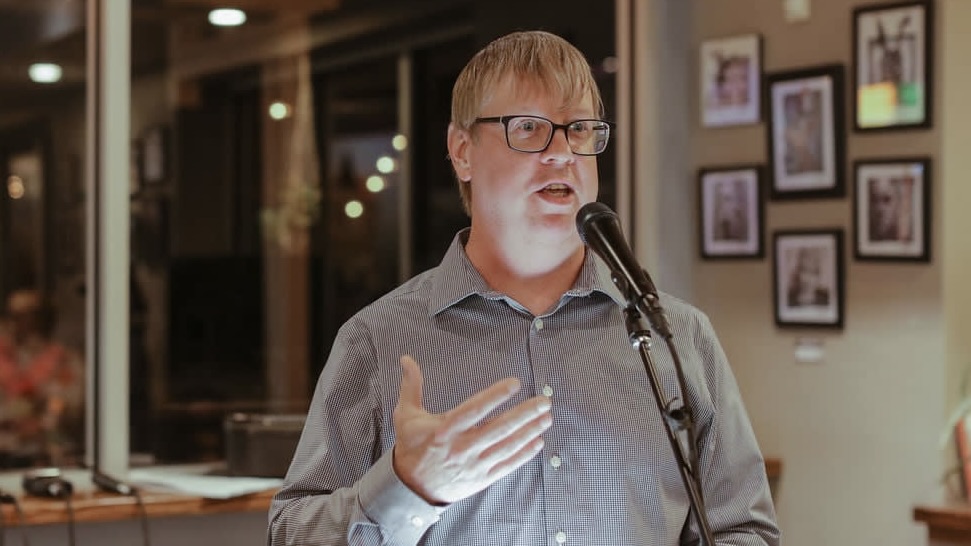
Episode 67 of Hooked on Creek features my conversation with author and longtime Max Creek fan Tom Flanagan.
Tom returns to the podcast to share a major update. His book, Max Creek: A Rumor in Their Own Time, is finished. In this episode, Tom discusses the three-year journey of documenting the band’s legacy, his emotional experience of writing the book, and some of the fascinating revelations that emerged during his research.
Learn more about Max Creek: A Rumor in Their Own Time and sign up for updates on the release of the book at maxcreekbook.com.
This episode features clips of the song Emerald Eyes performed live by Max Creek at Broadbrook Opera House in Broadbrook, Connecticut, on April 25, 2026.
Transcript of episode 67
You’re listening to Hooked on Creek, a podcast celebrating the music, history, and fans of the legendary jam band Max Creek. I am your host, Korre Johnson, and this is episode 67.
Welcome back to Hooked on Creek. I am really excited to share this episode with you because it features the return of author and longtime Max Creek fan Tom Flanagan. Tom first joined me back on episode 45 to talk about a new project he was beginning — a book entirely focused on the history and legacy of Max Creek. At that point, the book was still taking shape. Tom was deep into research, conducting interviews, and uncovering stories from throughout the band’s history.
Now, three years later, Tom is back with a major update. His new book is finished and it’s called Max Creek: A Rumor in Their Own Time.
In this episode, Tom shares details about the book and what it was like documenting the history of Max Creek and the community that surrounds the band. We talk about the origins of the project, the emotional experience of writing it, and some of the revelations that emerged along the way. Tom also discusses his interviews with people like Mike Gordon from Phish, John Bell from Widespread Panic, Dean Budnick from Relix magazine, and many others connected to the band’s history.
As someone who had the opportunity to read an early version of this book, I can tell you the book is incredibly thoughtful, deeply researched, and written with a genuine love and respect for the band. I think fans of Max Creek are really going to appreciate what Tom has created.
Now before I transition to my conversation with Tom, I want to let you know that you can learn more about the book and sign up to receive updates on the book’s release by visiting maxcreekbook.com. And if you head over to hookedoncreek.com, you can also find a full transcript of my conversation with Tom.
Alright, now let’s get started.
[interview begins]
Korre: Tom Flanagan, welcome back to Hooked on Creek.
Tom: Hey Korre, it’s great to be back. Second appearance, I love it.
Korre: Well Tom, it’s been about three years since we last talked on the podcast and back then, I think you were in the thick of doing research for the book and getting into writing the book. So, I think everybody wants to know, what is the status of this Max Creek book?
Tom: Yeah, great question, and I am happy to report that the book is done. Holy moly, the last three years have been a journey. You’re right, the last time I was a guest on this show, I was conducting interviews, I was researching the book. It turned into a much bigger project than I would have ever imagined, but in a good way. I’m just really thrilled with the outcome of the book.
So, I just put the final touches on the edits and now I’ll be sending it to a publishing house who might be interested in publishing it. And so, we’ll go from there and if people are wondering when the book will actually be available, it’ll be available later this year one way or another, for sure.
Korre: Well, let’s get some of the details here. What is the name of the book? What’s it called?
Tom: Great question, and so I kind of waffled back and forth with this one and so where I landed was A Rumor in Their Own Time. And so obviously that is a slogan near and dear to the Creek community and the band itself. It’s a slogan they used back in the day. My beta readers loved that title. I had a few alternative titles — working titles, if you will — and so I landed on that one.
Korre: We’ll talk more about the book here in a second, but for folks who maybe want to stay connected to you and your progress, where would they learn about the book or find out when it’s available?
Tom: I just launched the book website and so anybody can go to maxcreekbook.com. That’s just one word, maxcreekbook.com. You can actually download a free sample of the book. There’s a PDF there that you can download, and you can sign up for updates. That’s the best way to stay connected.
I threw a bunch of other stuff in there too, some old photos that were given to me working on the book. And I also spent a lot of time documenting the history of Camp Creek and so there’s a bunch of information on Camp Creek on the website. I think of the website as evergreen, I’m always going to be adding content, but that’s the best place to go check it out and get updates.
Korre: And Tom, you have written other books in the past, so this is not your first book. But when you look at this one particularly, why did you write this book?
Tom: Yeah, that’s a great question. So, it’s actually my third book. I had written a memoir, and I actually had written a novel. This book — not to be overly dramatic — but Max Creek holds a special place in my heart and preserving the band’s legacy is important to me.
And I’ll also say too, I’m an avid reader, so I read a lot of books on the jam band scene and the Northeast music scene and the history of that genre and it always irks me that Max Creek is never mentioned in many cases in these books. So, I decided, hey, I’m going to change that. I’m going to write an entire book about Max Creek, arguably one of the most influential jam bands in the history of the genre. And so that was important to me.
Korre: When you set out on this project, did you have specific goals in mind that you wanted to accomplish through this book?
Tom: Yeah, I mean, I think first and foremost my biggest goal was to explore why Max Creek didn’t have more commercial success, right? As a fan, not necessarily a writer, but as a fan, Max Creek is just such an amazing band, to this day they’re so amazing. And to see other bands that from a fan’s perspective that I thought went on to have tons of commercial success — bands we all know, and in some cases love — bands like Blues Traveler, Spin Doctors, Widespread Panic, Dave Matthews Band, all of these sort of 1990s H.O.R.D.E. [Horizons of Rock Developing Everywhere] tour bands ended up with a lot of commercial success.
From my standpoint as a fan, I said, I want to find out why Max Creek didn’t have more commercial success. Why isn’t there a Sirius Satellite Radio station dedicated to them? Why aren’t they in the Rock and Roll Hall of Fame? So on and so forth, because in my mind they should be. And so, a goal was to set out to find out why Max Creek didn’t have more commercial success, but boy did I find out there was a much richer story that was unearthed that had nothing to do with fame and fortune or commercial success. That’s the crux of the book and that’s the theme of the book.
Korre: Yeah, well, I think it was what, 1992 with that inaugural H.O.R.D.E. fest — Max Creek turned down that opportunity. And maybe without spoiling the book, what are your thoughts on that decision Max Creek made to step away from that tour?
Tom: Yeah, such a fascinating question and we could do multiple podcasts on this question alone, right? Such an incredible era of music, that early 1990s, 1992. One of the people that I interviewed in the book is Dean Budnick, he is the senior editor of Relix magazine. He coined and popularized the term “jamband.” He wrote two books entitled Jamband. He’s written many books on the Grateful Dead and worked with Peter Shapiro. And he’s from Rhode Island, my home state, which was really cool. And because he’s just such a seasoned journalist and a professional, he was a great interview.
And one of the things he had thought that maybe Max Creek just experienced this gap in time. Like timing is so important. By 1992, Max Creek was already a band for 21 years. And so, when you had these up-and-coming bands like Phish and Widespread Panic, the Aquarium Rescue Unit, and others, Max Creek had already been around for two decades.
And so there was some sort of, for lack of a better term, controversy. I know Scott has gone on the record numerous times saying that Max Creek turned down an opportunity to play the H.O.R.D.E. tour. I did speak with Mike Gordon and interviewed Mike Gordon for the book. Had great conversations with Mike and for the original one — original first H.O.R.D.E. tour — Max Creek wasn’t invited to play.
But when I chatted with John Bell —JB — from Widespread Panic, he had an interesting take. I asked him about Max Creek being included in H.O.R.D.E. tour and he thought that Max Creek was too big to play the initial H.O.R.D.E. tour, which I thought was a really interesting take because Widespread was coming out of Athens, Georgia, they were trying to break into the Northeast marketplace and they would open for Max Creek. And at that time in ’92, even Creek was bigger than Phish.
So collectively, and that’s the premise of the H.O.R.D.E. tour — Blues Traveler, Spin Doctors, Phish, Aquarium Rescue Unit — they all wanted to pool their resources so they could play summer amphitheaters. They certainly couldn’t sell out or host one of them on their own, so they figured they’d collaborate and pool their resources. And all those bands that I just mentioned thought Max Creek was too established, Max Creek was already too big, because Max Creek was at that time drawing far and away bigger concerts than those bands were.
Korre: Well Tom, I want to thank you for giving me the opportunity to be a part of your beta group that got to read an early version of this book. I found it fascinating and I highly recommend everybody check this book out when it comes out. I really enjoyed the perspectives that you were able to bring through some of the interviews in the book. Like you said, you talked to Mike Gordon and John Bell and some others. Who are some of the people that you had the most fun talking to in the book?
Tom: It made me so happy that so many people were so willing to be interviewed. Obviously, I just mentioned that I interviewed Mike Gordon, I interviewed JB from Widespread Panic. That was really cool because when I was chatting with their band’s manager, John Bell was like, “I want to take this interview myself, I love this band, I love Max Creek.” So that was really cool.
I also got to interview David Gans, who’s a great journalist and musician himself. He’s the co-host of Tales from the Golden Road on Sirius Satellite Radio, so David had some great thoughts on Max Creek as well. He actually had played Camp Creek once, so that was really cool. Dean Budnick, obviously the senior editor of Relix magazine, fantastic interview because he’s a pro’s pro. And he’s just so articulate and so dialed into the scene.
But I have to say some of my favorite interviews were Amy [Goodusky] and Linda [Cournoyer]. And boy, rock and roll is not for the faint of heart, and it was always back in the day a male-dominated sort of industry/vertical. And both Linda and Amy were just badasses. And I know Amy was a guest on Hooked on Creek and I just loved her interview with you as well, but Amy is just so thoughtful and so just in touch with her feelings and her experiences with the band. And she just had great insights.
I didn’t know her story. When I discovered Max Creek, she had already left the band. And so, to learn about her history, how well she’s doing in life now as a semi-retired lawyer, her relationship with Steve who was a roadie for Max Creek, and then the scandal that her dad was involved in in Connecticut. Not going to get too much into the details there, but in the book, I wasn’t aware of any of that situation. To see how much empathy Amy had for the band and her growing up in the band was just really great.
And Linda, Linda’s just fantastic. I mean, she is just so talented. Obviously, creating the lights for the band when lights didn’t exist. When Max Creek started out, they were bringing this arena-like experience to little clubs and barrooms across the Northeast. And Linda with John Rider building the lights from scratch. Also, her designing t-shirts and other swag and then also so talented designing the album covers and the work that she did. And she just has a wonderful story, and I don’t think she gets enough credit in the band.
I think she was one of those sort of unsung heroes in the band. And when she left the band, she left with no fanfare, she just kind of faded out. And as the industry changed and as venues changed — gosh now you can run an entire light show with an app on your iPad. You certainly couldn’t do that in the ’70s and ’80s, right? I just think she added so much to the history of Max Creek. And obviously, the band members adore her and love her, and the crew. But boy, I’m just so excited to share her story with the world and have other Creek Freaks read more about Amy and Linda.
Korre: Even hearing you talk about that reminds me of parts of your book that really focused on that sort of “do-it-yourself” mentality the band had when you think of what John Archer and John Rider were doing on the PA system or what Linda might have been doing in making shirts and the lighting rigs. When you learned more about this band and learned more about what it was like to be performing in clubs, what relationship do you think that sort of do-it-yourself ethos had to their success navigating the ’70s and ’80s in some of these bars and clubs?
Tom: That’s such a great topic to explore. I think a little bit it could be a double-edged sword. I mean, they did things that no band would do. Talk about do-it-yourself, like literally they wanted to print t-shirts, so they built a printing press. Like who does that, right? Like you could just use a third-party vendor and send your design work and have the t-shirts printed. They did everything in-house. Recording the early albums, they did it — the first few albums were all recorded and engineered themselves. I mean, they certainly worked with some great engineers, particularly at The 19, the studio in Connecticut.
But Mark Mercier alluded to this a little bit in the book, like sometimes they probably had too much of a do-it-yourself mentality. But impressive, nonetheless. I know the Grateful Dead gets a lot of credit for inventing a lot of that stuff, but boy Max Creek was, in my humble opinion, right there with the Grateful Dead just leaning into that do-it-yourself mentality.
Korre: In the book, you write about how founding member Dave Reed was fired from the band and also about how percussionist Rob Fried reportedly died of a broken heart. I’m curious as a lifelong fan of Max Creek, was it hard to learn about and write some of these more difficult sides of the band’s history?
Tom: Yeah, it was. I am balancing on one side, which is journalistic integrity, and then on the other side, as a fan. So obviously Dave Reed, a co-founder of the band, and I never got to see him play. I think he left the band perhaps even before I was born. So, I never saw Dave, but boy decades later you could just tell. I mean, it’s been decades, since the 1970s since he was in the band, and he’ll occasionally go back to the family reunions and play Back Porch Boogie Blues or something. But you could tell that those emotions were almost as raw today as they were decades ago.
That just tells me being in a band is not like having an office job. You quit your office job or you get fired, you’re not going to have the same emotional attachment as like creating something from the ether with your brother in arms. And so, I could tell Dave — he was a wonderful interview. He spent so much time with me doing interviews via Zoom, emailing back and forth, texting — great guy, he’s really excited to read the book. But even when he read some of the things that I had wrote from interviewing other people, there were some things that he didn’t know.
And he was personal friends with Bob Gosselin, they had grown up together, and it was Bob who had to tell Dave that he was no longer in the band. And that really put a rift in their friendship for many years. So, kind of gut-wrenching to not only interview and hear that but to write about it as well.
And with Rob, when I discovered Max Creek, Rob was like the rock star of the band. He was this larger-than-life personality. He was the band member that stood before and after the show signing autographs, having a drink with fans. Fans absolutely loved Rob, rightfully so. He’s this larger-than-life personality. I think one of his best friends that I interviewed for the book called him like the big teddy bear of the band, which is true.
But what I didn’t know is that sort of dark side to Rob. He had a temper. That temper came out when things didn’t go well — equipment breaks and the road crew has a lot of work to do. But as a journalist, you’ve got to tell all sides of the story, you want to be fair and balanced. And so, it was great to get all these sort of different sides of Dave and Rob.
And one of the things I’m really proud about with Rob is that I got to interview Moriah [Andrade]. I know you had Moriah on your podcast and she’s a wonderful music teacher, educator — and she also plays the flute in a band that covers Max Creek and Phish shows. And her mom dated Rob for some time back in the day when she was a little child. So, it was just fantastic to sort of also share that side of Rob that not many people would know — the side outside of music when he was sort of this adopted stepfather for Moriah. I think that’s really touching.
I think all great stories need conflict. You need to have ups and downs, and you need to have conflict, right? That’s the quintessential hero’s journey that everybody loves. That’s the formula people love. Nobody wants to read a story about a band where everything is just wonderful throughout. You need some adversity, you need some conflict. I think that’s what makes stories like the Grateful Dead, stories like the Rolling Stones, the Beatles — that’s why those stories are so fascinating, and they stick with us because there’s conflict and there’s adversity. And so Max Creek certainly had plenty of that.
Korre: What has been the reaction so far from the current band members to your writing the book and how have they engaged with you in this process so far?
Tom: Yeah, it’s been great. You know, Bill Carbone has been wonderful. Obviously, his day job is pretty fantastic, working for TeachRock.org. Love chatting with Bill, I know he’s super busy. My daughter goes to DU, the University of Denver, and she’s a sophomore. She had a project, a class project, where she had to interview a professional musician and ask them a bunch of questions and work on this project and Bill graciously volunteered to work with her on that. So, it was kind of cool that even my daughter got to spend some time with Bill. He’s super generous with his time. Obviously, he’s still going for his PhD and working on his thesis but he’s truly an academic and just a very thoughtful, articulate person.
So, it was great to spend time with Bill and to spend a little bit of time with Jay as well, and the current configuration of the band, which has been a band for a long, long time now — well over a decade. They were very supportive and obviously some I got to speak more than others, but it all balances out in the end.
Korre: In the book, you mention that writing this book brought out a tsunami of emotions and that you even cried typing the last sentence of the book. What was the most emotional or challenging part of this process? As a lifelong fan, what was it like to get to the end of this book?
Tom: Yeah, not to sound overly dramatic, but it is true, that is true, and I wrote that at the end of the book. I did cry, and when you work on a project for three years — I discovered Max Creek when I was gosh 15 or 16 years old, seeing them at The Living Room in Providence, Rhode Island. The first time I saw the band, the show changed my life, seriously, like that’s not platitude, that really happened.
The opportunity to give back to the community that gave me so much as a young adult in my formidable years, I feel like my life had come full circle. Also, I think life is challenging, right? I also have a demanding day job and a family. And so, all those trials and tribulations of everyday life come up and as they do for everybody. And three years is a long time and writing a book is a marathon. But I’m really happy with the quality of the book, that’s the most important thing, I wanted to put out a product that the band themselves would be proud of.
And also during those past three years, it was wonderful, I was able to reconnect with two old friends from back in The Living Room days that I used to spend time with. It was great to reconnect and chat about the book and then unfortunately they both passed before the book was completed.
I know Jyre [Heffron] was beloved in the Max Creek community and the band just did a little tribute for him and Mark Mercier’s wife Lori was super close with Jyre. He was one of my beta readers and he got to read the manuscript, so that makes me super happy, and it makes me super happy that his words are memorialized in the book.
And then I had another friend Jason who was unfortunately killed in Providence with a hit-and-run, and that crime still hasn’t been solved. It’s an unsolved mystery if you will, an unsolved murder.
And so that just is a microcosm. So all those emotions, setting out a big goal, working on a project for three years, dealing with everyday life, seeing two friends pass during the course of the project — all of those sort of emotions kind of boiled over at the end. Overall, just grateful that the project’s finished and can’t wait to put this project out in the universe.
Korre: What are some of the revelations you had in the process of writing this book?
Tom: Yeah, that’s a great question. I’ve seen the band gosh 150, maybe 200 times, and you think you would know a lot about a band or everything there is to know about a band seeing them that many times. But boy was I wrong, there was just so much to learn.
One of the things that was really revealing to me that I didn’t know too much about as a fan was in 1992 when Scott quit the band. So, he had formally quit the band, that was ‘92, that was during the beginning of the H.O.R.D.E. tour, the first one. And so, Scott had a young family. He needed medical benefits, he needed stability, he needed to provide for his family — a major turning point in the band. And so, I didn’t know how serious him leaving the band was, but it was very serious.
He had officially quit the band and had accepted a job in technology, which by the way he’s still a programmer, a developer — still a computer programmer to this day. He’s been burning the candle at both ends all of these years. Scott’s a great technologist, too. To learn about those inner workings, that’s all detailed in the book.
But as luck would have it, like many things in Max Creek’s history, Scott ended up not working a weekend job in technology, but working a Monday through Friday nine-to-five gig and that allowed him to play nights and weekends and Creek decided to stay as a unit with that lineup and with Scott. Obviously, it was the right decision, but that also is where you draw the line in the sand and that’s when Max Creek officially becomes a part-time band. They’re no longer going to be touring the United States in a van or Big Orange or some other touring van like other bands were doing.
It’s kind of interesting that probably held them back with some commercial success and bands like Phish obviously became household names and became huge bands over the years. But it also led to their longevity. So, it’s really this confluence of in 1992 Scott is going to leave the band, ultimately stays with the band, the band transitions to a part-time band and that is the catalyst for them to go on to still be a band to this day and to be a band for 55 years.
But at the same time, it’s also that exact same decision and that exact same scenario that probably limits them from growing beyond a regional band. But I will say, I think the fans prefer that. They prefer that all these decades later they’ve gotten to see Max Creek in New England and across the Northeast in really intimate venues and it really kept this dream of this community alive. John Rider’s premise for beginning the band was to give people a place to call home and they did that for decades — and I admire that.
Korre: What happens next for you? I mean, as an author or someone who’s looking to publish a book, are the next steps the easy part or the hard part?
Tom: Yeah, everything is difficult. So, the next thing is I’m just putting the final formatting on the manuscript, there’s just a lot of technical manual work that has to be done on the technical side, the digital side. That’ll be done this week and then I’m sending it off to a publisher who’s interested in publishing the book. That would be a wonderful opportunity. Actually, I’ve spoken to Bill Carbone about this and want to follow up with him. He has a lot of connections in the publishing space as well.
But at the very least, I will self-publish it, and I think that would be poetic, right? Like the entire band’s career and everything they did and some of the things you’ve already mentioned, that do-it-yourself mentality. There’s something just so fitting about self-publishing and do-it-yourself, but at the same time, I want this band to have the biggest audience possible, the most recognition possible. So nonetheless, this book will see the light of day later this year.
Korre: Tom, thank you so much for writing this book. As somebody who has spent the last seven years dedicating my weekends and nights to Max Creek in a podcast, I’m just so excited to see this book come out and I’m just so excited to have been able to read this early version of it and to finally have this documented for so long. I think the podcast has done something, but I think this book is going to do something completely else and just so excited for it.
Tom: Oh, I think the podcast has been amazing, I just want to take a moment to thank you, Korre, and all you’ve done for the community. As I always said, Hooked on Creek was a world-class podcast. The production was just so professional, the interviews were just so dialed in, you had great guests.
Also, for your listening audience, I also want to recognize that not only was Korre a beta reader for the book, but also, I interviewed him for the book, and he gave me permission to use his content and quotes in the book. And so, I don’t want to speak for the entire community, but I’m sure everybody just thanks you, Korre. Seven years of just incredible content, incredible interviews, just so professionally done. The entire community just is so grateful for this podcast. I just want to thank you.
Korre: Well, thank you for that. And you admitted that you had cried at the end of writing the book. I have shared once that I did cry when I went and saw Max Creek for the first time. That Sunday of Camp Creek, Mark Mercier acknowledged me from the stage, and this is my first experience seeing Max Creek, my first experience seeing people who listen to the podcast. And then the band moved into Gypsy Blue, and I had a very emotional moment. But there was another time, Tom, that’s when I was reading this early draft of the book and I saw my name in it.
Moments like that are hard for me to imagine even being possible frankly when I started the podcast by myself in the basement. I didn’t think I’d meet anybody, definitely didn’t think I’d meet the band, I certainly didn’t think I’d be talking to you about a book, and I certainly didn’t think I’d be in the book. So, this experience for me in the podcast has been one of the most rewarding things that’s ever happened to me in my life.
For those who’ve been listening to the last episode and following me on the Hooked on Creek Facebook group, you’ve heard that the podcast is getting close to an end. I don’t know exactly when it’s going to end, but it probably will be soon. So just so excited to have this opportunity to talk with you, Tom, again about the book and to get this update and really excited to see this thing come out, so thank you really.
Tom: Well, thank you, Korre, that was just so well said. And I’m so glad we had an opportunity to meet in person, to get to meet you at your second Camp Creek, which was my first Camp Creek in over 20 years. That’s the magic of this community, that’s the magic of Max Creek. And so again if anybody wants to learn more about the book, they can go to maxcreekbook.com, that’s maxcreekbook.com. Sign up for updates, read a free sample, and feel free to drop me a line. I’d love to hear from you.
Korre: Tom Flanagan, thank you for joining me again on the Hooked on Creek podcast.
Tom: It’s been a dream and thanks for having me, Korre.
[interview ends]
Big thanks again to Tom Flanagan for joining me on the podcast. I always have a lot of fun talking with him. And please, head over to maxcreekbook.com right now and sign up to get updates on the release of his new book Max Creek: A Rumor in Their Own Time.
If you are curious, this episode featured clips of Max Creek performing the song Emerald Eyes live at Broadbrook Opera House in Broadbrook, Connecticut, on April 25, 2026.
That concludes episode 67 of Hooked on Creek. If you have feedback about this episode, please visit hookedoncreek.com and click the contact link to send me a message. I would love to hear from you. Thanks for tuning in!